For a more upbeat read, check out this blogpost by "A UK Law Firm Librarian" on the "magical" law library staff. It points out that law librarians are magicians, quietly working behind the scenes to make sure that the books, databases, legal news, and legal research needs of the lawyers (and law faculty) are accessible and everyone is happy.
Of course everybody knows that.
Tuesday, 19 July 2011


Dispriting New York Times article on law school economics
You can pretty much tell from the title of the article in the Sunday NYT, "Law School Economics: Ka Ching!" that this isn't going to be encouraging for potential law students. Sure enough, the report focuses on the broken incentives that lead law schools to constantly raise class sizes and tuition costs despite a massive recession in the legal market. The article uses New York Law School, the stand-alone law school in lower Manhattan, as an example of what's wrong with law school economics.
Today Dean Matasar, who is mentioned frequently in the Times article, posted his response on the New York Law School website. In his reply he refutes or explains a number of the points made by the NYT reporter. His argument is that:
"The article is misleading because it fails to acknowledge that:
1. Costs are outside of the control of any one school.
2. A legal education provides lifelong value.
3. Students can and do make informed decisions.
4. NYLS provides one of the most student-centric and innovative programs in the country."
Today Dean Matasar, who is mentioned frequently in the Times article, posted his response on the New York Law School website. In his reply he refutes or explains a number of the points made by the NYT reporter. His argument is that:
"The article is misleading because it fails to acknowledge that:
1. Costs are outside of the control of any one school.
2. A legal education provides lifelong value.
3. Students can and do make informed decisions.
4. NYLS provides one of the most student-centric and innovative programs in the country."
Monday, 18 July 2011
Microsoft announces project to assist scholarly empirical research
Microsoft has announced a new project, Daytona, that is designed to give scholars better tools for manipulating and analyzing empirical data. According to a post in the Chronicle's Wired Campus blog, the announcement was made during Microsoft's annual Faculty Research Summit, which focused this year on research around natural user interface technology, cloud computing, and machine learning. More information is available on the Microsoft Research website.
Libraries opting out of subscription "packages"
The Chronicle of Higher Education has an article about academic libraries deciding to opt out of "packages" (termed "Big Deals") of journal subscriptions that publishers/vendors customarily offer. Instead, libraries are going through and making individual decisions about keeping or cancelling journal subscriptions, resulting in overall cost savings. The article says: "As publishers point out, Big Deals put an abundance of information at researchers' fingertips. More and more, though, librarians respond that a lot of that material doesn't get used. "'We were getting a lot of titles, but a large number of them were getting little or no usage.'" And, according to the article, "the consequences many libraries have feared—loud objections from faculty members and financial penalties from publishers—have not come to pass."
Nauru launches comprehensive legal database
Nauru, the world's smallest island nation, located in the South Pacific, has just recently launched a comprehensive legal database containing the country's legislation and court opinions, according to a report from Radio New Zealand International. The database is called RONLAW (www.ronlaw.org), and is the result of an eighteen month effort by the Legal Information Access Project, funded by New Zealand and overseen by the Nauru Office of Parliamentary Counsel. Over the course of the project Nauru's legislation was consolidated - a huge task, given that the last consolidation was in 1937. RONLAW, which stands for Republic of Nauru Law, contains the Constitution, Nauruan legislation, court decisions, gazettes and other relevant documents; over time, according to the website, "RONLAW will grow to house historical versions of legislation, all subordinate legislation and court decisions. As new legislation is passed in Nauru RONLAW will be updated to include that material, and amendments will be incorporated into consolidated versions of legislation within 24 hours of of being made. Superseded versions of legislation will progressively be added to the collection of historical legislation."
Friday, 15 July 2011
Digital Preservation Courses and Workshops
The Library of Congress has created a national calendar of digital preservation courses and workshops as part of its Digital Preservation Outreach and Education (DPOE) initiative, an effort "to foster national outreach and education to encourage individuals and organizations to actively preserve their digital content." LOC is keeping the calendar current by scanning the web daily for new class postings. They also ask providers to submit information about their courses. Many of these courses are online and some are free.
Hat tip: Margie Maes at the Legal Information Preservation Alliance (LIPA)
Hat tip: Margie Maes at the Legal Information Preservation Alliance (LIPA)
Wednesday, 13 July 2011
Universal Citation meeting during AALL
A group of law librarians and legal educators interested in pursuing the goal of a uniform legal citation format is convening for the first time during the AALL annual conference. The group has a website, UniversalCitation.org, that explains the purpose of the meeting and has a link where you can register to attend (at no cost). The meeting will be held on Monday, July 25, from 9am to 12 noon, at the Rutgers-Camden School of Law, Room E112. Yes, it's in another city in another state, but it is an easy and very short subway ride from the convention location in Philly, just across the Delaware River, so the location shouldn't be a barrier to attendance.
From the webpage: "As legal research shifts to a digital environment, there is a growing need for a new way to refer to court decisions and other documents on which the law depends. With the potential for great increases in the availability of legal information, there needs to be a citation style that does not depend on the increasingly outdated print editions that form the basis for legal reference. As of this date, several American jurisdictions have adopted a Universal Citation format, but most have not. There are a variety of reasons why courts have hesitated to adopt Universal Citation, but given its success as a citation form in the jurisdictions that have adopted it, and the ease with which it has been adopted in Canada, United Kingdom, Australia, and elsewhere, its value and utility are hard to deny. Given this continued reliance on print citations, and the restrictions that this places on open access to the law.... Universalcitation.Org is being organized to fill the gap."
From the webpage: "As legal research shifts to a digital environment, there is a growing need for a new way to refer to court decisions and other documents on which the law depends. With the potential for great increases in the availability of legal information, there needs to be a citation style that does not depend on the increasingly outdated print editions that form the basis for legal reference. As of this date, several American jurisdictions have adopted a Universal Citation format, but most have not. There are a variety of reasons why courts have hesitated to adopt Universal Citation, but given its success as a citation form in the jurisdictions that have adopted it, and the ease with which it has been adopted in Canada, United Kingdom, Australia, and elsewhere, its value and utility are hard to deny. Given this continued reliance on print citations, and the restrictions that this places on open access to the law.... Universalcitation.Org is being organized to fill the gap."
West Publishing history featured in the Green Bag
The latest edition of The Green Bag has an entertaining look at a 1901promotional pamphlet published by West publishing called "Law Books by the Millions: An account of the largest law-book house in the world, the home establishment of the National Reporter System and the American Digest System". An introductory essay by Ross E. Davies discusses this historic artifact and how it illustrates that the more things change, the more things remain the same. For example, the pamphlet describes the lawyers working on theditorial staff : "as a body there is not another to match it. The tests given applicants make it certain that only lawyers of West Publishing Co.
more than average ability, and with special mental aptitude for this class of work, are engaged in this very important position. A lawyer of scholarly tastes and abilities finds a more attractive field in legal literary work than in the competitive struggle which awaits him if he enters the practice, and the rewards, if less dazzling, are more assured."
more than average ability, and with special mental aptitude for this class of work, are engaged in this very important position. A lawyer of scholarly tastes and abilities finds a more attractive field in legal literary work than in the competitive struggle which awaits him if he enters the practice, and the rewards, if less dazzling, are more assured."
Monroeville restaurant makes the news by banning young children
Many news outlets are carrying the story of a Monroeville restaurant that has announced it will no longer allow children under age 6 to dine at the establishment. McDains Restaurant, located at 4440 Broadway Boulevard in Monroeville, started as the "19th hole" for the McDain's Golf Club and proved so popular that it developed into an "upscale, quiet and casual" restaurant with outdoor dining. Owner Mike Vuick announced the ban on children under 6 after he'd received noise complaints from customers about crying kids at neighboring tables. In an email to customers, Vuick explained: "We feel that McDain's is not a place for young children. Their volume can't be controlled and many, many times, they have disturbed other customers." The Reuters story asks if this is legal, and answers Yes; while restaurants can't discriminate against race, color, religion or national origin, "Nowhere in that list is there a category for "kids."
Tuesday, 12 July 2011
World Statistics visualization project
The World of 100 is an interesting visualization project that looks at world statistics. Artist Toby Ng looks at various statistics asking the question: "If the world were a village of 100 people, how would the composition be?" He has built a set of 20 posters visualizing various world statistics. For example, the "Languages" poster shows that if the world were a village of 100 people, 17 would speak Chinese, 9 would speak English, 8 would speak Hindi, 6 would speak Russian, 6 would speak Spanish, 4 would speak Arabic, and 50 would speak "other languages".


Law Technology News: web tools
A recent article in Law Technology News by Louis Abramovitz, a Washington D.C.-based law librarian, provides a list of free and low-cost online resources now available to lawyers, including websites for Pubic Records searches.
Database: Gender Law Library
The Gender Law Library is a collection of national legal provisions impacting women's economic status in 183 economies (it is hosted by the World Bank, and supported by the World Bank’s Gender Action Plan and the Norwegian Trust Fund). The database can be used for comparative analysis of legislation affecting women. It serves as a resource for research, and contributes to reforms that can enhance women’s full economic participation. The materials are generally organized into categories including geographic region, income level grouping, legal topic, and type of law. The collection is updated regularly.
hat tip: InSITE
hat tip: InSITE
Monday, 11 July 2011
TRAC vs. SSA
The Transactional Records Access Clearinghouse recently published a report titled Social Security Awards Depend More on Judge than Facts: Disparities Within SSA Disability Hearing Offices Grow. Embedded in the report is a special interactive table giving the public access to extensive counts and rates that further document the degree of the disparities among individual judges in a Social Security hearing office as well as disparity measures for each office as a whole.
In response, the Social Security Administration published a statement sharply criticizing TRAC's study on several different grounds. TRAC has now issued a point-by-point refutation of the SSA's sweeping statement regarding TRAC's original report.
Transactional Records Access Clearinghouse is a non-partisan research organization associated with Syracuse University. Using Freedom of Information Act requests, the organization gathers highly detailed but easy-to-access information on selected federal enforcement agencies, special topical reports, and "bulletins" about federal enforcement, staffing and expenditures. .
In response, the Social Security Administration published a statement sharply criticizing TRAC's study on several different grounds. TRAC has now issued a point-by-point refutation of the SSA's sweeping statement regarding TRAC's original report.
Transactional Records Access Clearinghouse is a non-partisan research organization associated with Syracuse University. Using Freedom of Information Act requests, the organization gathers highly detailed but easy-to-access information on selected federal enforcement agencies, special topical reports, and "bulletins" about federal enforcement, staffing and expenditures. .
2011 National Strategy for Counterterrorism released by White House
The White House recently released its new counterterrorism strategy, the National Strategy for Counterterrorism (19 page pdf). They also released a Fact Sheet that summarize the strategy, saying that "this strategy builds upon the progress we have made in the decade since 9/11, in partnership with Congress, to build our counterterrorism and homeland security capacity as a nation. It neither represents a wholesale overhaul-nor a wholesale retention-of previous policies and strategies... This Strategy stands to testify to our friends, our partners, and to our terrorist enemies: Here is our plan of action to achieve the defeat of al-Qa‘ida and its affiliates and adherents . It is this outcome we seek, and indeed it is the only one we will accept ."
Contents include:
Contents include:
- The Threat We Face
- Principles That Guide our Counterterrorism Efforts
- Overarching Goals
- Area of Focus
- Other Terrorist Concerns Requiring Focus and Attention
- Conclusion
Wikipedia Higher Education Summit
Inside Higher Education reports that Wikipedia, in its efforts to improve and expand its relationship with academia, held the first Wikipedia in Higher Education Summit last week. Attendees were professors who have actively incorporated Wikipedia into their teaching, as well as faculty who are interested in doing so. According to the report, over two dozen universities now have courses where students are working on Wikipedia as part of their formal coursework, and many of these campuses have “Wikipedia ambassadors” tasked with helping professors weave writing and editing Wikipedia entries into the syllabus. David Ferriero, Archivist of the United States, was the speaker who gave the opening address, saying that his office at the National Archives and Records Administration now employs a “Wikipedian in residence” in charge of fostering relationships with galleries, libraries, archives and museums.
At the Summit, Carnegie Mellon University researcher Rosta Farzan demoed a set of new course software tools aimed at making it easier for professors to assign and evaluate Wikipedia-related assignments. The free software includes a dashboard for instructors to track student work and provide private feedback on edits, as well as a new course page builder to help instructors create useful and well-structured course pages.
At the Summit, Carnegie Mellon University researcher Rosta Farzan demoed a set of new course software tools aimed at making it easier for professors to assign and evaluate Wikipedia-related assignments. The free software includes a dashboard for instructors to track student work and provide private feedback on edits, as well as a new course page builder to help instructors create useful and well-structured course pages.
Chief Justice John Roberts on relevance (or irrelevance) of legal academia
A recent post on the Legal Skills Prof Blog points to an interview with U.S. Supreme Court Chief Justice John Roberts at the Fourth Circuit Court of Appeals' 77th annual judicial conference. A video of the 47 minute interview is available on C-Span.
The blogpost specifically talks about Justice Roberts' comments on the relevance of legal scholarship to the practice of law, as evidenced by law review publications. You can watch this part of the interview by forwarding the video to minute 28:50. Dean Raymond C. Pierce of the North Carolina Central University School of Law in Durham, N.C., poses this question to Chief Justice Roberts:

The blogpost specifically talks about Justice Roberts' comments on the relevance of legal scholarship to the practice of law, as evidenced by law review publications. You can watch this part of the interview by forwarding the video to minute 28:50. Dean Raymond C. Pierce of the North Carolina Central University School of Law in Durham, N.C., poses this question to Chief Justice Roberts:
“Your comments earlier about the use of your law clerks caused me to think about a comment by Judge Harry Edwards of the D.C. Court of Appeals where Judge Edwards strongly suggests that our judiciary on all levels, and the practicing bar, are unfortunately too disconnected from our academies, from our law schools. I want to know your thoughts on that as to whether or not you agree with that or whether you think the relationship between the practicing bar and the bench, and our legal academy, our lawschools is fine, or whether or not there is some impact on instruction as it relates to the good future of our profession.”Chief Justice Roberts replies:
"Judge Edwards and I are on the same page on that point. There IS a great disconnect between the academy and the profession. Pick up a copy of any law review… and the first article is likely to be (on an abstract topic) that I’m sure is of great interest to the academic who wrote it, but isn’t of much help to the bar. Now I hasten to add, I don’t think there’s anything wrong with that. If the Academy wants to deal with the legal issues at a particularly abstract and philosophical level that’s great, that’s their business, but they shouldn’t expect that it would be of any particular help or even interest to members of the practicing bar or judges. At the same time we’re not looking for vocational guidance like “this is how you fill out the form for an entry of appearance”. At the same time, I do think that if the academy is interested in having an influence on the practice of law, on the development of law, they would be wise to stop and think, “Is this area of research going to be of help to anyone other than other academics?”. It’s their business, but people ask me what the last law review article I read was, and I have to think very hard before coming up with one."

Wednesday, 29 June 2011
CALI News
News from the Center for Computer Assisted Legal Instruction, aka CALI:. Starting this school year, CALI lessons will have a very new look. The educational content remains the same, but the new-look versions include a number of new features including iPad and iPhone compatibility, auto scoresave, and easy copy & paste.
You can register for an upcoming live webcast about the new CALI lesson on July 12, 3PM Eastern, 2PM Central. The webcast will cover what's changing in CALI Lessons, the expected time line for implementation, and provide time for answering questions. Faculty can preview of the new viewer on each lesson description page. Click the lesson title - not the play button - from the listings, and then click on the link that says "Try the new lesson viewer (alpha)".
You can register for an upcoming live webcast about the new CALI lesson on July 12, 3PM Eastern, 2PM Central. The webcast will cover what's changing in CALI Lessons, the expected time line for implementation, and provide time for answering questions. Faculty can preview of the new viewer on each lesson description page. Click the lesson title - not the play button - from the listings, and then click on the link that says "Try the new lesson viewer (alpha)".
Tuesday, 28 June 2011
LexisAdvance & WestlawNext, two views
Two interesting discussions of the two big new legal research products have been published online and provide a lot of food for thought for law librarians and legal researchers. Ron Wheeler, from Univ. of San Francisco School of Law & Director of the law library has a paper on SSRN titled "Does Westlaw Next Really Change Everything: the Implications of WestlawNext on Legal Research". And Dan Baker of the University of Houston O'Quinn Law Library has published Part 1 and Part 2 of his First Thoughts on Lexis Advance for Law Schools on the library's blog.
Tuesday, 14 June 2011
EBSCO, H.W. Wilson merge
Publishers and database vendors EBSCO and H.W. Wilson have announced that the two companies have merged as Ipswich, MA-based EBSCO acquiring the staff and product lines of H.W. Wilson Co. According to the announcement, the “vast majority of Wilson databases will continue to be maintained, and there are many planned enhancements. Some Wilson databases will be merged together with closely related EBSCO databases to create more robust versions.”

Chart of forthcoming changes and enhancements due to merger provided by EBSCO.

Chart of forthcoming changes and enhancements due to merger provided by EBSCO.
ABA moves to improve law school employment data accuracy
The National Law Journal reports that the ABA's section on Legal Education and Admissions to the Bar has approved changes to the annual law school questionnaire that require more detailed information on the employment status and salaries of law school graduates. Law schools will be required to report in much greater detail on the types of jobs in which their graduates have found employment. They will also have to provide information on graduates who are unemployed or whose employment status is unknown.
Project will digitize older Technical Reports
The Technical Report Archive & Image Library (TRAIL) is an initiative led by the University of Arizona in collaboration with the Center for Research Libraries to identify, digitize, archive, and provide access to federal technical reports issued before 1975. These technical reports communicate research progress in technology and science and deliver information for technical development to industry and research institutions contributing to the continued growth of science and technology. While availability to more recent (1994–current) technical report literature has greatly improved with Internet access, legacy technical report documents remain elusive, and this initiative aims to close that gap. Some of the report series digitized include divisions of the U.S. Atomic Energy Commission; U.S. National Bureau of Standards, the U.S. Bureau of Mines and more.
Thursday, 9 June 2011
NTIS Technical Reports
The June 2011 NTIS Technical Reports Newsletter (from the US Dept. of Commerce National Technical Information Service) is now available online. This issue has been designated as a Special SLA Edition to correspond with NTIS’ participation at the Special Libraries Association (SLA) Annual Conference, and the issue highlights the topic The Virtual World. It features enhanced graphics and design, and includes selected information from the NTIS Subject Categories:
• Communication (45)
• Computers, Control & Information Theory (62)
• Library & Information Sciences (88)
If you are attending this year’s SLA Conference, the NTIS will be previewing the National Technical Reports Library (NTRL) Repository Beta Version 2.0.
• Communication (45)
• Computers, Control & Information Theory (62)
• Library & Information Sciences (88)
If you are attending this year’s SLA Conference, the NTIS will be previewing the National Technical Reports Library (NTRL) Repository Beta Version 2.0.
Tuesday, 7 June 2011
Libguides for (ProQuest) Congressional databases
The editorial team at ProQuest, the company that recently bought the Congressional databases from Lexis, has created a collection of useful bibliographies that provide links to documents in the Congressional databases on current topics. The bibliographies are on the following topics; when you click on the link, click on the blue tabs at the top of the page that say "Committee Prints and CRS Reports", "Hearings", and/or "Congressional Record" for live links into the Barco databases. You need to be on campus or accessing via the Pitt remote server to use these.
Al Qaeda http://proquest.libguides.com/al_qaeda
Egyptian Revolution http://proquest.libguides.com/egyptian_revolution
Gas Prices http://proquest.libguides.com/gas_prices
Haitian Earthquake (updated) http://proquest.libguides.com/haitian_earthquake
Health Care Reform http://proquest.libguides.com/health_care_reform
Immigration and Naturalization http://proquest.libguides.com/immigration_and_naturalization
Libyan Unrest http://proquest.libguides.com/libyan_unrest
Natural Disasters http://proquest.libguides.com/natural_disasters
North Korea (updated) http://proquest.libguides.com/north_korea
Nuclear Crisis in Japan http://proquest.libguides.com/nuclear_crisis_in_japan
Osama bin Laden http://proquest.libguides.com/osama_bin_laden
Same Sex Marriage (updated) http://proquest.libguides.com/same_sex_marriage
U.S. Natural Disasters http://proquest.libguides.com/natural_disasters
Al Qaeda http://proquest.libguides.com/al_qaeda
Egyptian Revolution http://proquest.libguides.com/egyptian_revolution
Gas Prices http://proquest.libguides.com/gas_prices
Haitian Earthquake (updated) http://proquest.libguides.com/haitian_earthquake
Health Care Reform http://proquest.libguides.com/health_care_reform
Immigration and Naturalization http://proquest.libguides.com/immigration_and_naturalization
Libyan Unrest http://proquest.libguides.com/libyan_unrest
Natural Disasters http://proquest.libguides.com/natural_disasters
North Korea (updated) http://proquest.libguides.com/north_korea
Nuclear Crisis in Japan http://proquest.libguides.com/nuclear_crisis_in_japan
Osama bin Laden http://proquest.libguides.com/osama_bin_laden
Same Sex Marriage (updated) http://proquest.libguides.com/same_sex_marriage
U.S. Natural Disasters http://proquest.libguides.com/natural_disasters
Monday, 6 June 2011
Newspaper Map
The Newspaper Map website is a visual map where you can identify newspapers from all over the world, translatable to and from many languages with one click. In many cases you will also find links to the newspapers sites on social media like YouTube, Twitter and Facebook. You can search for specific cities or newspapers, filter by language, or look for historical newspapers that are available online.
Friday, 3 June 2011
A Mullet view of law school?
The Chronicle of Higher Education this afternoon has a brief article titled "Overcoming a "Mullet" View of Faculty". The author defines a "mullet" view : a university president told him that when new faculty attended their first faculty meeting, the "serious" ones sat in front, with the malcontents and disengaged at the back. Hence the mullet: professional in front, party behind. The author said professors tend to view the way students choose classroom seats in the same way: A’s in the front, C’s in the back. Is this true in law schools too?
Wednesday, 1 June 2011
Electronic course packs
The Wired Campus blog reports on a couple of University of Chicago graduate students who have launched an online version of coursepacks called Sibylus "the syllabus, reimagined". The students realized that the photocopied materials they were buying from the bookstore in coursepacks are available online to students via the databases licensed by the university; or even on free websites.The students—who are both studying business and law—started a pilot program this spring in several classes at Chicago’s business school . The online coursepacks aren't free, but they are cheaper than the photocopied versions sold by the bookstore.
Public Libraries
The New York Review of Books blog has a post titled "A Country Without Libraries". It is a pretty wonderful essay on the value of public libraries, and the disheartening news of how many public libraries are being closed or having their hours curtailed.
Here's some of the essay:
Over the years I thoroughly explored many libraries, big and small, discovering numerous writers and individual books I never knew existed, a number of them completely unknown, forgotten, and still very much worth reading. No class I attended at the university could ever match that. Even libraries in overseas army bases and in small, impoverished factory towns in New England had their treasures, like long-out of print works of avant-garde literature and hard-boiled detective stories of near-genius. Wherever I found a library, I immediately felt at home."

Here's some of the essay:
Over the years I thoroughly explored many libraries, big and small, discovering numerous writers and individual books I never knew existed, a number of them completely unknown, forgotten, and still very much worth reading. No class I attended at the university could ever match that. Even libraries in overseas army bases and in small, impoverished factory towns in New England had their treasures, like long-out of print works of avant-garde literature and hard-boiled detective stories of near-genius. Wherever I found a library, I immediately felt at home."

The main branch of the Scranton public library, where this blogger spent many happy hours.
Wednesday, 25 May 2011
Judgmental website: UK case law made usable
Judgmental is a new UK website that aims to make UK case law "available, searchable and usable". The case law is browsable by jurisdiction and court, and then by date. The entire set of data can be searched by Google.
As for the spelling of the website's name, the website says "Why doesn't it have an 'e" in it?
"Judgment" is the usual spelling for an act of legal adjudication, and is similarly used in the Bible, eg Day of Judgment. "Judgement" is used in the wider sense, for instance when referring to someone as having "sound judgement". Who knew?
As for the spelling of the website's name, the website says "Why doesn't it have an 'e" in it?
"Judgment" is the usual spelling for an act of legal adjudication, and is similarly used in the Bible, eg Day of Judgment. "Judgement" is used in the wider sense, for instance when referring to someone as having "sound judgement". Who knew?
Tuesday, 24 May 2011
This year's outstanding govt. information resources announced
Each year, the Notable Documents Panel of the American Library Association Government Documents Round Table (GODORT) recognizes outstanding government information resources issued by state and local governments, national governments, and intergovernmental organizations, such as the World Bank and the UN. This year's report from the panel is titled "Digital Diamonds and Budget Cuts," has been published in Library Journal. The report points out that the strides made by GPO during that past year are "tempered by the prospect of massive federal budget cuts that will likely slow down progress." Among GPO's successes this year are the successful migration of millions of documents from GPO Access to FDSys, which has implemented archival standards for long-term preservation of important documents.
The subject matter of this year’s Notable Documents list reflects an essential characteristic of these releases: their diversity. Nearly half of these titles focus on animal and plant life, climate change, and the environment. Half of the remaining titles deal with social topics, such as crime, human rights violations, economic development, the global economic crisis, and the wars in Iraq and Afghanistan. City planning, construction, history, food and gardening, geospatial data, and engineering are among other themes addressed. The number of works available only in print, only online, and in both analog and digital media is roughly equal.
The list of this year's Notable Documents available online includes:
The subject matter of this year’s Notable Documents list reflects an essential characteristic of these releases: their diversity. Nearly half of these titles focus on animal and plant life, climate change, and the environment. Half of the remaining titles deal with social topics, such as crime, human rights violations, economic development, the global economic crisis, and the wars in Iraq and Afghanistan. City planning, construction, history, food and gardening, geospatial data, and engineering are among other themes addressed. The number of works available only in print, only online, and in both analog and digital media is roughly equal.
The list of this year's Notable Documents available online includes:
- The Crime of Family Abduction: A Child's and Parent's Perspective (57 page pdf) distributed by the national Criminal Justice Reference Service
- Fannie Mae, Freddie Mac, and the Federal Role in the Secondary Mortgage Market (55 page pdf) published by the Congressional Budget Office
- The State of the Hudson website published by the New York State Dept. of Environmental Conservation (online only).
- Gender and Governance in Rural Services: Insights from India, Ghana, and Ethiopia (332 page pdf) published by the World Bank & International Food Policy Research Inst.
- Latin America and the Caribbean: Atlas of Our Changing Environment website published by the UN Environment Programme, includes satellite images, thematic maps and statistics as well as environmental profiels of 65 countries.
Monday, 23 May 2011
LLMs face increased scrutiny
The National Law Journal has a story (note: you must register for a free 90day trial to NLJ to access the online article) today titled "Increased scrutiny for LL.M.s: New hurdles, options for foreign-trained attorneys". LL.M. programs offer the master of laws degree for foreign lawyers who want to be eligible to take the bar exam in the US. The article notes two shifts affecting LL.M. students: first, the New York Court of Appeals has adopted stricter requirements for the curricular content of LL.M. programs. Secondly, the ABA's Section of Legal Education and Admissions to the Bar has proposed specific curriculum requirements for LL.M. programs geared toward foreign-trained lawyers. Individual states adopting the proposed model would then allow LL.M. program graduates to take their bar exams.
Netflix is the top bandwidth use in North America
Techradar reports that the Netflix video streaming service is not the biggest user of bandwidth in North America, accounting for 22% of total internet use. These figures come from the recent Global Internet Phenomena Report (18 page pdf) by Sandvine Broadband Network Solutions. At peak periods, Netflix accounted for 29.7% of bandwidth use. If you add in other forms of "real-time entertainment" - sites providing on-demand streaming - they account for almost half of bandwidth use. The report includes data on bandwidth use in Europe and Latin America, as well as an analysis of how the Royal Wedding on April 29, 2011, affected internet use worldwide.


Friday, 20 May 2011
West Virginia closes regional law libraries
The Intelligencer/Wheeling News-Register reports that regional W. Va. law libraries are being closed "because of a lack of use". In the article, the administrative director of the W. Va. Supreme Court of appeals said they have been considering the closure for several years, and a a study conducted in the Huntington law library found that in a 3 month period nobody used the library. He also said that judges in the 1st Judicial Circuit have first pick of the books, and a community college is interested in using the books for its paralegal training program.
Wednesday, 18 May 2011
Turnitin study on student plagiarism using the internet
Turnitin, the online plagiarism resource used by Pitt, recently conducted a study that examined which Internet sites students use in their written work. They looked at 40 million student papers submitted to Turnitin over a ten-month period. Some of their findings:
• One third of "matched content" (content that has been copied) is from social networks, content sharing or question-and-answer sites where users contribute and share content.
• 15 % of content matches come from cheat sites.
• One fourth of matched content is from legitimate educational web sites, almost double the number that comes from paper mills or cheat sites.
• Wikipedia is the most popular site for matched content (7%). The other most popular sites, in order, are answers.yahoo.com, answers.com, slideshare.net, oppapers.com, scribd.com, coursehero.com, and medlibrary.org.
• Institutions with widespread adoption of Turnitin see a reduction in unoriginal content of 30-35 % in the first year. By the fourth year, many institutions see levels of "unoriginality" fall by up to 70 %.
You can request a free download the White Paper, "Plagiarism and the Web: Myths and Realities," from the Turnitin website.
• One third of "matched content" (content that has been copied) is from social networks, content sharing or question-and-answer sites where users contribute and share content.
• 15 % of content matches come from cheat sites.
• One fourth of matched content is from legitimate educational web sites, almost double the number that comes from paper mills or cheat sites.
• Wikipedia is the most popular site for matched content (7%). The other most popular sites, in order, are answers.yahoo.com, answers.com, slideshare.net, oppapers.com, scribd.com, coursehero.com, and medlibrary.org.
• Institutions with widespread adoption of Turnitin see a reduction in unoriginal content of 30-35 % in the first year. By the fourth year, many institutions see levels of "unoriginality" fall by up to 70 %.
You can request a free download the White Paper, "Plagiarism and the Web: Myths and Realities," from the Turnitin website.
AP Stylebooks addresses digital terminology
The new edition of the AP Stylebook, a style and usage guide used by journalists (it calls itself "the journalists' Bible), clarifies the spelling of some digital terminology and has also added commonly used acronyms. For example, "email" is now spelled without a hyphen or capitalization, and both "cellphone" and "smartphone" are one word. The acronym "ROFL" (rolling on the floor laughing) has been added.
Tuesday, 17 May 2011
New à la carte libraries from Hein coming in June
HeinOnline is introducing two new à la carte libraries on June 1, 2011. The first is the History of International Law Collection, which will contain more than 500 titles and 550,000 pages dating back to 1690 on subjects such as War & Peace, the Nuremberg Trials, Law of the Sea and International Arbitration. It will include classic books and serials such as the International Law Studies Series [U.S. Naval War College], International Conciliation, and Studies in Transnational Legal Policy.The second is the Hague Academy of Collected Courses which will include the complete archive of collected courses dating back to their inception in 1923, twelve periodic indexes, plus the official publications from the Workshops organized by the Academy.
Sunday, 15 May 2011
NTIS offers new service for getting federal technical reports
The National Technical Information Service (NTIS) has announced the availability of a new information dissemination service known as NTIS Selected Research Service (SRS). NTIS serves as the largest central resource for government-funded scientific, technical, engineering, and business related information; federal agencies are required to make copies of their scientific and technical reports available to NTIS. The SRS is a tailored information service that delivers complete electronic copies of government technical publications from agencies such as the Department of Defense (DOD), National Aeronautics and Space Administration (NASA), Department of Energy (DOE), and the Environmental Protection Agency (EPA). The program offers:
The cost of each document you request from this NTIS program is $3.00. The 378 subject areas are detailed in the SRS Catalog (pdf).
- Full Text PDF format of Federal technical reports
- Comprehensive coverage of Federal technical content
- Ability to select from 378 subject categories
- E-mail notification when new documents in subject areas of interest are available.
The cost of each document you request from this NTIS program is $3.00. The 378 subject areas are detailed in the SRS Catalog (pdf).
Friday, 13 May 2011
E-reserves trial to begin Monday
Ars Technica reports that on Monday May 16 the e-reserves lawsuit pitting several academic publishers (Cambridge, Oxford and Sage) against Georgia State University will begin in the Northern District Court of Georgia. E-reserves are electronic compilations of course material that faculty gather for students in circumstances where they would not be using enough material to make it worthwhile for students to buy entire books. According to Ars Technica the issue is "notoriously murky", and in this case the publishers approached Georgia State before embarking on the lawsuit, but the university claimed the e-reserves were legal. The publishers are suing Georgia State on the claims of contributory infringement and indirect infringement.
CIA declassifies oldest documents
The CIA's Freedom of Information Act Electronic Reading Room provides public access to CIA information that has been released through the FOIA and other disclosure statutes. Recently they added the US government's 6 oldest classified documents, which have finally been declassified. The documents date from 1917 and 1918, and were the only documents remaining classified from the World War I era. These documents all describe methods of "secret writing" that spies might use to sneak information past the enemy. Document 4, for example, has several methods - tedious and involving chemicals and hot irons - for exposing hidden writing. Document 4 also describes "how to open sealed letters without detection" which involves copper acetyl arsenite, acetone and amyl alcohol (though there is a notation in the margin saying "Tried - not successful"). Document 6 warns to "Suspect fresly-painted metal walls on ships, etc. - Often... they cover communications scratched on the underlying metal surface". It also gives instructions on "how to make microscopic writing on a 2-cent red U.S. postage stamp", and warns that "spies and smugglers" sometimes engrave messages on toe-nails.
Wednesday, 11 May 2011
National Jukebox from LOC
The Library of Congress recently launched the "National Jukebox: Historical Recordings from the Library of Congress."Jukebox, which makes historical sound recordings available to the public free of charge. The Jukebox includes recordings from the collections of the LOC Packard Campus for Audio Visual Conservation and other contributing libraries and archives. Recordings in the Jukebox were issued on record labels now owned by Sony Music Entertainment, which has granted LOC a gratis license to stream acoustical recordings. Currently, the Jukebox includes more than 10,000 recordings made by the Victor Talking Machine Company between 1901 and 1925. According to the LOC, Jukebox content will be increased regularly, with additional Victor recordings and acoustically recorded titles made by other Sony-owned U.S. labels.
You can browse the contents in a variety of ways, including by language, place, label, date, composer, lyricist, performer and genre. The collection includes recordings of vocal music, instrumental music, as well as spoken recordings.
According to the LOC site, "The goal of the Jukebox is to present to the widest audience possible early commercial sound recordings, offering a broad range of historical and cultural documents as a contribution to education and lifelong learning. These selections are presented as part of the record of the past. They are historical documents which reflect the attitudes, perspectives, and beliefs of different times. The Library of Congress does not endorse the views expressed in these recordings, which may contain content offensive to users."
Here's an example of a 1906 recording of "Home Sweet Home."
You can browse the contents in a variety of ways, including by language, place, label, date, composer, lyricist, performer and genre. The collection includes recordings of vocal music, instrumental music, as well as spoken recordings.
According to the LOC site, "The goal of the Jukebox is to present to the widest audience possible early commercial sound recordings, offering a broad range of historical and cultural documents as a contribution to education and lifelong learning. These selections are presented as part of the record of the past. They are historical documents which reflect the attitudes, perspectives, and beliefs of different times. The Library of Congress does not endorse the views expressed in these recordings, which may contain content offensive to users."
Here's an example of a 1906 recording of "Home Sweet Home."
US District Court for the Western District of PA: PDF/A filing requirement begins phasein June 1
The Federal Judiciary is planning to change the technical standard for filing court documents in PACER from PDF to PDF/A. According to the Administrative Office of the U.S. Courts this change will improve the archiving and preservation of case-related documents. Each federal court is to set its own deadline date for setting the requirement in place, and the US District Court for the Western District of PA has announced that it will begin posting documents in PDF/A format on June 1, 2011 and that all uploaded court filings must be in PDF/A format beginning on Jan 1, 2012.
The PIT IP Tech Blog (from the Pittsburgh law firm of Picadio Sneath Miller & Norton) has a post explaining what PDF/A means, and pointing to online resources that can help with the transition. According to their post, "In theory, by moving to the PDF/A format, electronically-filed documents will be more accessible in the future and less dependent on technologies or features that may become unsupported."
hat tip: Law.com legal blog watch
The PIT IP Tech Blog (from the Pittsburgh law firm of Picadio Sneath Miller & Norton) has a post explaining what PDF/A means, and pointing to online resources that can help with the transition. According to their post, "In theory, by moving to the PDF/A format, electronically-filed documents will be more accessible in the future and less dependent on technologies or features that may become unsupported."
hat tip: Law.com legal blog watch
Forum on the future of the CRS
The Congressional Research Service (CRS) is a nonpartisan government agency located within the Library of Congress that provides policy and legal analysis to members of Congress on a wide range of issues.
On Monday, the Sunlight Foundation hosted a forum to discuss the current state of the CRS as well as its future. A panel of speakers talked about the expertise of CRS analysts, the relevance of CRS Reports, and the possibilities for improving public access to CRS Reports that are not considered confidential. A video of the forum is available on C-SPAN (90 minutes). During the discussion, it was reported that a Transparency Bill, that would make CRS reports already in existence public, will be reintroduced this session of Congress as well as a separate, stand-alone CRS bill mandating public access (possibly through Clerk of House/Senate)
On Monday, the Sunlight Foundation hosted a forum to discuss the current state of the CRS as well as its future. A panel of speakers talked about the expertise of CRS analysts, the relevance of CRS Reports, and the possibilities for improving public access to CRS Reports that are not considered confidential. A video of the forum is available on C-SPAN (90 minutes). During the discussion, it was reported that a Transparency Bill, that would make CRS reports already in existence public, will be reintroduced this session of Congress as well as a separate, stand-alone CRS bill mandating public access (possibly through Clerk of House/Senate)
Monday, 9 May 2011
The Economist on the business of law
The May 5 edition of The Economist online has a story titled Law firms: A less gilded future discussing changes in the "legal business" over the past few years. The article describes how the recession hit the lawyering profession hard- even American firm Howrey, one of the top 100 firms in the world, went bust because of dismal profits. The article says that "(u)ltimately, lawyering is becoming more of a business than a profession. Some lawyers decry this. Others welcome it. Few deny it. Because the American market cannot grow as it used to, firms will have to find new strategies and make use of sophisticated branding to stand out."
hat tip: Mike Madison
hat tip: Mike Madison
Friday, 6 May 2011
Cost Effective research training
Everyone (ok, everyone who is a law librarian and tweets) is tweeting about a blogpost by DC lawyer Jean O'Grady titled "The Myth and the Madness of Cost Effective Lexis and Westlaw Research Training". It is well worth reading, if somewhat depressing. The basic premise is that focusing on "cost effectiveness" distracts summer associates from the real goal of legal research, which is finding the right answer for the client. The big database vendors could do a lot to gear their databases towards focusing on finding the right answer, rather than worrying about lots of tangential pricing factors - but they don't. Instead they offer highly complex, opaque and expensive research tool that in some ways defeats the real purpose of legal research.
College bookstores asks BBB to investigate Amazon claims
Inside Higher Education has a story today reporting that the National Association of College
Stores (NACS) has asked the Better Business Bureau to investigate advertising claims made by Amazon on the Amazon textbook page. The page claims that one can "Save up to 90% on used textbooks and up to 30% on new textbooks, then get up to 60% back when you sell textbooks back at Amazon". Then on Tues May 3, Amazon filed a Complaint for Declaratory Judgement (15 page pdf) in the US District Court, Western District of Washington, asking the court to "grant relief against NACS" by declaring that the Amazon pricing claims are NOT misleading, and asking that Amazon be awarded its costs and expensives of litigation as well as "such other and further relief as the Court deems just and equitable".
Stay tuned.
Stores (NACS) has asked the Better Business Bureau to investigate advertising claims made by Amazon on the Amazon textbook page. The page claims that one can "Save up to 90% on used textbooks and up to 30% on new textbooks, then get up to 60% back when you sell textbooks back at Amazon". Then on Tues May 3, Amazon filed a Complaint for Declaratory Judgement (15 page pdf) in the US District Court, Western District of Washington, asking the court to "grant relief against NACS" by declaring that the Amazon pricing claims are NOT misleading, and asking that Amazon be awarded its costs and expensives of litigation as well as "such other and further relief as the Court deems just and equitable".
Stay tuned.
Wednesday, 4 May 2011
FBI warning: bin Laden links may contain malware
The Federal Bureau of Investigation (FBI) warned computer users Tuesday to be cautious about opening emails claiming to include photos or videos of Osama bin Laden's death. Such emails may contain viruses that could steal personal information and spread throughout your email Contacts list.
Tuesday, 3 May 2011
Nolo Publishing sold to new media company
Publishers Weekly reports that Nolo Inc. has been sold to Internet Brands, a "new media" Internet company. Nolo was founded in Berkeley, CA in the late 1960's by two legal aid lawyers who assembled a group of radical lawyers, editors, and writers frustrated by a legal system too complicated and pricey for much of the US middle class. They began publishing plain-English books with information about dealing with a variety of everyday legal situations. Internet Brands was founded in 1998 as CarsDirect.com and has diversified its interests into many including legal, careers and shopping. Internet Brands will keep Nolo in Berkeley where Nolo's operations will be combined with those of ExpertHub (www.experthub.com), Internet Brands' existing legal-focused division, with domains including Nolo.com, LawFirms.com and CriminalDefenseLawyer.com. PW says that Nolo's print operations will continue under Interrnet Brands.

Nolo publishers in 1971
Monday, 2 May 2011
Legal Information Preservation Alliance celebrates Preservation Week
Last week LIPA, the Legal Information Preservation Alliance, highlighted true stories of recent preservation projects undertaken by LIPA member libraries. Every day LIPA published one story about a digital law library project, with details about the planning and executing of the project. Today they published all of the stories on the LIPA website (LIPA is a committee of AALL). The projects include an Indian Law portal developed by the state law library of Montana, digitized legislative histories of the Indiana General Assembly from 1858 to 1887 by the Indiana U. law library, and the digitization of Nebraska Supreme Court briefs by the Creighton University School of Law library.
A movement to allow erasure of internet information
MIT's Technology Review has an article on further developments in the "Right to be Forgotten" movement in Europe. The article says that a "growing group of privacy advocates in the U.S. and abroad want the Internet to be written in pencil" (allowing for erasure). They want internet users to have to opt IN before anyone could track their data in the first place. Spain is just the latest country that has become involved in the movement, when its Data Protection Agency ordered Google to remove hyperlinks to articles about 90 people. The article reports that in the U.S. an online-safety organization called Common Sense Media argued that "Web companies should develop tools that make it easier for young people—or their parents—to completely opt out and delete this information." They wanted, they said, an "Internet Erase Button."
There are 2 sides to the "internet erase button" or Right to be forgotten" argument though. There are sticky questions about freedom of the press and freedom of speech; when does the right to privacy outweigh the right to information? And the information that is available on the internet can also make all sorts of academic research much easier and less expensive. For example, the Wall Street Journal recently published an article on how women and men behave differently in looking at sexual content on the web - research that was accomplished by analyzing a billion web searches by men and women. The research was done by computational neuroscientist Ogi Ogas who has published the book A Billion Wicked Thoughts.
There are 2 sides to the "internet erase button" or Right to be forgotten" argument though. There are sticky questions about freedom of the press and freedom of speech; when does the right to privacy outweigh the right to information? And the information that is available on the internet can also make all sorts of academic research much easier and less expensive. For example, the Wall Street Journal recently published an article on how women and men behave differently in looking at sexual content on the web - research that was accomplished by analyzing a billion web searches by men and women. The research was done by computational neuroscientist Ogi Ogas who has published the book A Billion Wicked Thoughts.
Book statistics
The University of Dayton Erma Bombeck Writers' Workshop for humor writers has a list of statistics on the reading and publishing of books that bibliophiles might find depressing. The statistics come from various sources; one can only hope that some of them may be questionable. For example:
- 1/3 of high school graduates never read another book for the rest of their lives.
- 42 percent of college graduates never read another book after college.
- 80 percent of U.S. families did not buy or read a book last year.
- 70 percent of U.S. adults have not been in a bookstore in the last five years.
- Each day in the U.S., people spend 4 hours watching TV, 3 hours listening to the radio and 14 minutes reading magazines. (hat tip: Library and Information Science News blog)
And if you find this interesting, you might also be interested to learn that Inside Higher Ed reports the University of Denver's library plans to move 4/5 of the collection to off-site storage, in order to add more seating and group space during a major renovation. The library's 1.1 million books, gov docs, journals, microfiche and CDs will all be moved to an off-site storage facility 10 miles from campus during the renovation; only 20% of the material will return to the library when the renovation is completed.
Wednesday, 27 April 2011
Thomas is Tweeting!
The Law Library of Congress has announced a new Twitter account for Thomas: @THOMASdotgov .
The @THOMASdotgov account will provide alerts on THOMAS updates,and bills being considered on the floor of Congress; it will also serve as a venue for feedback on THOMAS.gov. You can read more about it on the LLOC In Custodia Legis blog post.
The LLOC can also be found online at:
- LLOC Twitter account.
- iTunes U
- Facebook
- YouTube
The @THOMASdotgov account will provide alerts on THOMAS updates,and bills being considered on the floor of Congress; it will also serve as a venue for feedback on THOMAS.gov. You can read more about it on the LLOC In Custodia Legis blog post.
The LLOC can also be found online at:
- LLOC Twitter account.
- iTunes U
- YouTube
Tuesday, 26 April 2011
British Library buys poet's emails
The Chronicle of Higher Education reports that the British Library (sort of the UK version of the Library of Congress) has purchased the emails of critically and popularly acclaimed poet, Wendy Cope. The archive of emails, dating from 2004 to the present, comprises about 40,000 emails for which the British Library paid £32,000 (over $50,000). The emails are part of a "hybrid archive" of Ms. Cope's work which has both paper and electronic materials and contains poetic and literary drafts, personal and professional correspondence, and other content. Ms. Cope told The Independent that many of the emails “are not interesting at all.”
Monday, 25 April 2011
What do you call a librarian?
(Former) librarian Michelle Mach has created an online list of Real Job Titles for library & information science professionals. The list came from jobs that have been advertised in professional organization publications and job titles that employed librarians have sent her.
There are a lot of them.
There are a lot of them.
Regulation Room project and airline passenger rights
We told you about Regulation Room when it was in beta testing in 2009. The positive effects that the project is having can be seen in the final version of the Dept. of Transportation’s recent airline passenger rights rule study, where DOT refers to the Regulation Room project throughout the final set of rules. The Preamble mentions that the Regulation Room website contributed a summary of the public discussion of the proposed rule(s) and that DOT’s research partnership with the Cornell project is meant to advance public participation in the rulemaking process.
Not only does DOT discuss Regulation Room comments almost every topic covered by the rules, but on the topic of Full Fare Advertising, Regulation Room comments directly influenced the DOT decision to make a policy change on advertising disclosures (Regulation Room commenters felt that current airfare advertising amounted to, in the commenters quoted words, “a bait and switch” tactic; airline companies commented that they did not want this policy change). Regulation Room sees this as an example of its success at helping ordinary people get their voice heard by an agency and the agency following the ordinary commenters wishes over business interests.
The final Airline Passenger Rights rule is available here.
Not only does DOT discuss Regulation Room comments almost every topic covered by the rules, but on the topic of Full Fare Advertising, Regulation Room comments directly influenced the DOT decision to make a policy change on advertising disclosures (Regulation Room commenters felt that current airfare advertising amounted to, in the commenters quoted words, “a bait and switch” tactic; airline companies commented that they did not want this policy change). Regulation Room sees this as an example of its success at helping ordinary people get their voice heard by an agency and the agency following the ordinary commenters wishes over business interests.
The final Airline Passenger Rights rule is available here.
Wednesday, 20 April 2011
Report shows recent law grads satisfied with real-world training
The National Association for Legal Professionals (NALP) has published report (41 page pdf) of a survey that they conducted with 930 law firm associates recently graduated from law school. The survey looked at the experiential learning opportunities - clinics, externships and pracitical skills courses - offered by law schools, and at how valuable these opportunities were for law students. The survey indicated that clinics and externships are gaining in popularity, as newer associates reported higher rates of participation in those courses than did earlier associate classes. The results showed that while many students don't take clinics or externships most of those who do participate considered the experience valuable. Externships and field placements had an especially high level of student satisfaction, with 60% of the associates involved calling the experience "very useful" - the highest ranking on the survey's scale of answers.
Tuesday, 19 April 2011
Chronicle: Can technology save legal education?
The Chronicle of Higher Education's Wired Campus blog has a post titled "Can technology save legal education?" about the recent Future Ed 3 conference attended by law-school deans and faculty. One of the deans is quoted as saying that “Legal education significantly lags the rest of higher education in integrating online learning and other educational technologies into its programs.” At the conference, the Apps for Justice proposal (created by a team including Professor Ronald W. Staudt of the Chicago-Kent College of Law and John Mayer, Executive Director of CALI) to “expand programs in which [law] students write software as part of their [legal] education,” was recognized with an award. The proposal includes further development of law-school clinical programs that use the A2J Author software created by CALI and the Center for Access to Justice and Technology.
A better link shortener
OK, maybe finding a better link shortener is low on your priority list. But Technology Review reports on a new link shortener that not only shortens links but also alters webpages for good readability. The service, called rdd.me, cleans all the junk ads etc. out of websites to make them blessedly easy to read. The abovementioned Technology Review article features a good example.
Wednesday, 13 April 2011
ULS libguides by subject
If you are searching for an article in the University Library System's digital library, and want to search in a specific subject area, you may notice there has been a change in how the interface directs your search. Instead of just listing relevant databases for the subject, ULS has developed LibGuides in the subject areas, that give more information about where to look for information. For example, the libguide for Law and Legal Studies databases is here.
Tuesday, 12 April 2011
Craigslist Foundation launches LikeMinded, hoping to inspire voluntarism
The Craigslist Foundation today launched LikeMinded, a project that aims to use the power of online organizing to help people volunteer to improve their communities. The Foundation wants to “empower people to strengthen their communities by connecting them to the resources they need to effectively engage in community building.” LikeMinded is conceived as a database of successful civic projects that can assist and inspire people in farflung communities facing similar problems to develop their own successful projects.
There is a series of video tutorials on the LikeMinded site that explain the project's goals in more depth.
There is a series of video tutorials on the LikeMinded site that explain the project's goals in more depth.
Copyright troll Righthaven drops lawsuit after judge blasts tactics
The Denver Daily News reports that copyright infringement firm Righthaven and the Denver Post have dismissed a $150,000 lawsuit they filed after a blogger used a Post photo on his website. The notice for dismissal was filed after the judge in the case denied Righthaven a motion for an extension. In this case, Righthaven had filed a $150,000 suit against Brian Hill, a 20 year old, chronically ill, mildly autistic blogger. According to the Denver Westword blog, "Typically, Righthaven obtains copyrights for material that's already been used in unauthorized fashion (like a Post photo of a TSA agent Hill published on his www.uswgo.com site), then sues for big bucks in the apparent hope of a speedy settlement. For instance, Righthaven offered to let Hill off the hook for $6,000 - an enormous sum given that he and his mom are both subsisting on disability payments. He has brittle diabetes, and she has to monitor him at night to make sure he doesn't lapse into a coma."
Judge John Kane, in denying the motion for extension, blasted Righthaven's tactics, saying "Plaintiff’s wishes to the contrary, the courts are not merely tools for encouraging and exacting settlements from Defendants cowed by the potential costs of litigation and liability."
Techdirt says, "it's looking like more and more judges are recognizing that the new found love of copyright trolls, to use the US judicial system as a shotgun to force people to pay settlement fees, is not a proper use of the courts".
Judge John Kane, in denying the motion for extension, blasted Righthaven's tactics, saying "Plaintiff’s wishes to the contrary, the courts are not merely tools for encouraging and exacting settlements from Defendants cowed by the potential costs of litigation and liability."
Techdirt says, "it's looking like more and more judges are recognizing that the new found love of copyright trolls, to use the US judicial system as a shotgun to force people to pay settlement fees, is not a proper use of the courts".
Monday, 11 April 2011
In England, legal services offered at WH Smith newsstands
Legal Week reports that UK law firm franchise QualitySolicitors (QS) has agreed a deal with WHSmith to offer legal services via hundreds of the newsagent's national branches - a move that has been hailed as a ground-breaking initiative for the retail legal market. QualitySolicitors will place 'legal access points' in 150 WHSmith stores this summer with a plan for eventually providing 500 locations.
The 'access points' will be staffed by local QualitySolicitors firms. Solicitors will offer advice on a range of consumer legal matters including conveyancing (real estate transfers) and will writing. There will also be a television advertising campaign to promote the product. Staff solicitors will use iPads and iPad applications to book appointments, provide conveyancing quotes, sell will packages and give advisory sessions for a fixed fee. QS chief executive Craig Holt said ‘This move represents the future of legal services. It is a game changer, providing both the key elements required for market dominance – accessibility and visibility.’ The goal of the partnership is to provide more accessible, consumer-friendly legal advice.
The 'access points' will be staffed by local QualitySolicitors firms. Solicitors will offer advice on a range of consumer legal matters including conveyancing (real estate transfers) and will writing. There will also be a television advertising campaign to promote the product. Staff solicitors will use iPads and iPad applications to book appointments, provide conveyancing quotes, sell will packages and give advisory sessions for a fixed fee. QS chief executive Craig Holt said ‘This move represents the future of legal services. It is a game changer, providing both the key elements required for market dominance – accessibility and visibility.’ The goal of the partnership is to provide more accessible, consumer-friendly legal advice.
Wednesday, 6 April 2011
FOIA Project website
The folks from Syracuse University's Transactional Records Access Clearinghouse (TRAC) have started an all new website called The FOIA Project. TRAC gets a lot of their data through filing FOIA requests to government agencies and courts. The new project is designed to bring more transparency to FOIA withholding decisions and enable users to track all instances in which a federal agency's decision to deny government records has become the subject of a suit under the Freedom of Information Act (FOIA) since October 1, 2009. The site, supported with a grant from the CS Fund/Warsh-Mott Legacy, is updated daily with the latest court FOIA filings and provides extensive information about the names of withholding agency, the names of the plaintiffs, the location where the action was brought, along with the actual complaint and attachments that were filed.
TRAC was established at Syracuse more than two decades ago to obtain detailed information from various federal agencies under the FOIA, check its accuracy and completeness and make the data available to the public through its two web sites, TRAC and TRACFED. Over the years, this effort has required TRAC to file suits in federal court against the Internal Revenue Service, the Office of Personnel Management, the National Archives and Records Administration, and various components of the Justice Department including the Executive Office for U.S. Attorneys and the Civil Division. If you visit their websites you will see that they are still litigating a number of FOIA requests for information.
TRAC was established at Syracuse more than two decades ago to obtain detailed information from various federal agencies under the FOIA, check its accuracy and completeness and make the data available to the public through its two web sites, TRAC and TRACFED. Over the years, this effort has required TRAC to file suits in federal court against the Internal Revenue Service, the Office of Personnel Management, the National Archives and Records Administration, and various components of the Justice Department including the Executive Office for U.S. Attorneys and the Civil Division. If you visit their websites you will see that they are still litigating a number of FOIA requests for information.
Federal Citizen Information Center partners with Google Books for free access to publications
The U.S. General Services Administration (GSA) has announced that it is working with the U.S. Government Printing Office (GPO) and GPO’s relationship with the Google Book Partner Program to make popular Government publications available for free electronic download through Google. Savvy citizens know that since 1970, GSA’s Federal Citizen Information Center has been distributing consumer publications from the Public Documents Distribution Center in Pueblo, Colorado. Publications range across all sorts of topics, from hiking maps of national scenic trails to restaurant safety tips to how-to guides on buying a used car. In the last 40 years, the program has distributed more than 800 million publications. Now the FCIC is making the 100 most popular government publications available for free download to your desktop, laptop, e-reader or smartphone.
ThomsonReuters sued by Findlaw bloggers
The San Francisco Weekly reports that a lawyer/journalist who blogged for Findlaw is leading a class action lawsuit against Findlaw owner Thomson Reuters, claiming the employees were overworked and underpaid. Attorney Jason Beahm says that he and his fellow Findlaw bloggers worked more than 8 hours a day without getting paid any overtime or getting proper meal breaks.
Tuesday, 5 April 2011
Professor arrested over laptop confrontation with student
The Wired Campus Blog reports that A college professor at Valdosta State University teaching a class on Law and the Ethics of Media has been charged with battery after a student told police the prof shut her laptop on her hands. According to the Valdosta State newspaper, the Spectator, Asst. Prof. Frank Rybicki, who was teaching a class on The Law and Ethics of Media in the Mass Media department, closed a laptop on the hands of student Dorsena Drakeford because he thought she was looking at non-class-related websites. The student argued with Prof. Rybicki about closing her laptop and about the websites she looked at while in class; the professor became upset and dismissed class early. The student went to the Valdosta State University Police Department and reported an assault.
The Spectator report said that many students in the Mass Media department are concerned about the status of Prof. Rybicki's classes and about losing the professor, who is, according to one student interviewed "one of the best teachers in the mass media (department)."
The Spectator report said that many students in the Mass Media department are concerned about the status of Prof. Rybicki's classes and about losing the professor, who is, according to one student interviewed "one of the best teachers in the mass media (department)."
Monday, 4 April 2011
Proposed legislation would eliminate printing of the Congressional Record
The Government Relations Office of the American Association of Law Libraries (AALL) has sent out an alert about a newly-introduced bill, Congressional Record Printing Savings Act of 2011 (S. 674). The bill, introduced by Sen. Tom Coburn (R-OK) and Sen. Herb Kohl (D-WI), would eliminate the print Congressional Record, except for a small number determined necessary for archival purposes. The Congressional Record would only be available electronically for most purposes.
The Congressional Record is on the Government Printing Office’s Essential Titles List, and the AALL strongly believes that federal depository libraries must continue to have the option of receiving it in print. The AALL has an online action alert with more information.
The Congressional Record is on the Government Printing Office’s Essential Titles List, and the AALL strongly believes that federal depository libraries must continue to have the option of receiving it in print. The AALL has an online action alert with more information.
Friday, 1 April 2011
SUV crashes into Moot Court Judges' Chambers
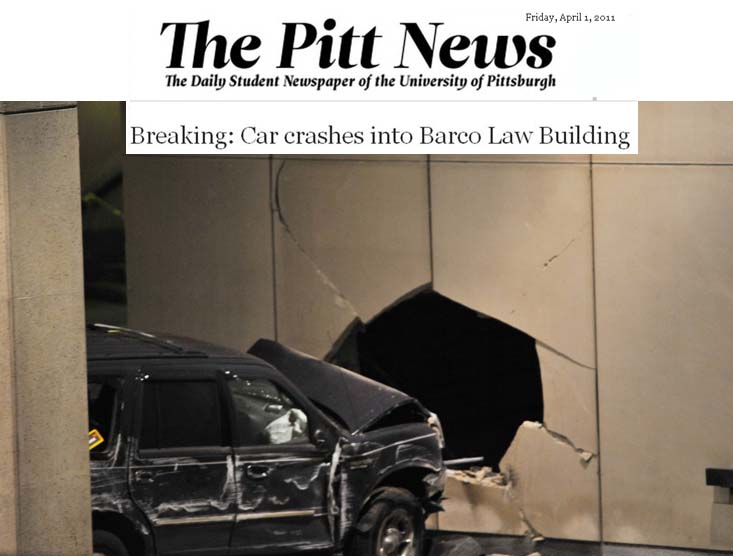
From The Pitt News:
A woman crashed a vehicle into the Barco Law Building yesterday shortly after 10 p.m., leaving her dark Ford SUV embedded in the concrete wall...Witnesses said the vehicle came out of the Towers garage, heading straight toward David Lawrence Hall and the Barco Law Building.The scraps of black plastic left behind made it look as if the woman had driven between two concrete pillars about 15 feet apart, straight through a narrow space between the curve of David Lawrence and another pillar about 10 feet away, and then down the nearby stairs before making impact with the Barco Law Building.
(The woman driving the car) was conscious and alert when paramedics carried her out on a stretcher at about 10:30 p.m...She was taken to UPMC Presbyterian Hospital. Her condition was not made public by midnight last night.
A woman crashed a vehicle into the Barco Law Building yesterday shortly after 10 p.m., leaving her dark Ford SUV embedded in the concrete wall...Witnesses said the vehicle came out of the Towers garage, heading straight toward David Lawrence Hall and the Barco Law Building.The scraps of black plastic left behind made it look as if the woman had driven between two concrete pillars about 15 feet apart, straight through a narrow space between the curve of David Lawrence and another pillar about 10 feet away, and then down the nearby stairs before making impact with the Barco Law Building.
(The woman driving the car) was conscious and alert when paramedics carried her out on a stretcher at about 10:30 p.m...She was taken to UPMC Presbyterian Hospital. Her condition was not made public by midnight last night.
Wednesday, 30 March 2011
New York Times online erects paywall
The New York Times online version, which used to be free, has begun charging subscription fees; the reasoning and the methodology was explained on Monday in a letter to the readers from publisher Arthur Sulzberger Jr. Currently they only have a single-subscriber pricing model available, with various permutations that are explained on their FAQ page. The Christian Science Monitor (ironically) has a clearer description of the available options as well as discussion of how the move is being viewed by media scholars and others.
Shpoonkle: eBay for Lawyers
A student at New York Law School has created some waves in the legal establishment by starting a website called Shpoonkle: Justice You Can Afford!. The site, which has been described as eBay for lawyers, allows lawyers and law firms to bid on legal requests submitted by clients. Lawyers, law students, and clients looking for a lawyer can register at the site. The Mission of Shpoonkle is "to provide a service that makes it as easy as possible for everyone to find affordable legal representation." The ABA Journal reports that the legal community's response to the website has been mixed.
Wednesday, 23 March 2011
So many databases...
So little time. We tend to focus on the major databases for lawyers, legal scholars and law students that the Barco Law Library provides, but sometimes should remind folks that through the vast collections of both the law library and the University of Pittsburgh Library System we have access to many interesting and random digital collections. For example, reading about Prof. Jessie Allen's blog, Blackstone weekly, reminded me that our quirky LLMC Digital collection contains the whole Yale Blackstone Collection; though not all of it has been digitized yet. Eventually they will get around to digitizing the whole collection. But meanwhile they have a number of old editions of Blackstone's Commentaries available in pdf format; as well as some American editions, abridgements, parodies, quizzes, and others. It's fun to peruse the collection.
Also today we learned that Prof. McCarthy had a letter responding to an earlier article on the constitutionality of health reform published in the New York Review of Books. We quickly pointed out that the article and exchange of correspondence are available via Pitt's electronic NYRB subscription. Pitt has so many electronic resources that it's always a good idea to check PittCat for any journal or publication you are interested in reading.
Also today we learned that Prof. McCarthy had a letter responding to an earlier article on the constitutionality of health reform published in the New York Review of Books. We quickly pointed out that the article and exchange of correspondence are available via Pitt's electronic NYRB subscription. Pitt has so many electronic resources that it's always a good idea to check PittCat for any journal or publication you are interested in reading.
E-Textbook study
The Chronicle of Higher Education's Wired Campus Blog reports that California State University is running one of the nation’s largest pilot studies of e-textbooks, involving thousands of students, and it seems that whether or not students like digital textbooks depends on the terms publishers set on how the ebooks can be used. Usage terms such as whether a student can print the whole book or only a portion of it, or whether the text can be downloaded to a computer or only accessed online, have a strong effect on how students view the ebooks.
The university system has prepared a preliminary report that was first reported last week by Converge Magazine.
The study involved 3,870 students in 30 courses where an e-textbook was assigned. Thousands more students were in a control group of similar courses using traditional textbooks. Of the 662 students who answered a survey after the fall semester about one-third said they were satisfied with the experience, one-third said they were neutral, and one-third said they were dissatisfied.
Students who were assigned e-textbooks were more likely to buy the book than those in courses that required traditional texts, which university officials took as a positive result. In the survey, 73 percent of students in e-textbook courses bought the course material, while only 46 percent of students in traditional courses bought the book. University officials believe that the lower cost of the electronic texts led to the increase.
The university system has prepared a preliminary report that was first reported last week by Converge Magazine.
The study involved 3,870 students in 30 courses where an e-textbook was assigned. Thousands more students were in a control group of similar courses using traditional textbooks. Of the 662 students who answered a survey after the fall semester about one-third said they were satisfied with the experience, one-third said they were neutral, and one-third said they were dissatisfied.
Students who were assigned e-textbooks were more likely to buy the book than those in courses that required traditional texts, which university officials took as a positive result. In the survey, 73 percent of students in e-textbook courses bought the course material, while only 46 percent of students in traditional courses bought the book. University officials believe that the lower cost of the electronic texts led to the increase.
Tuesday, 22 March 2011
Cornell won't sign nondisclosure agreements with vendors
The Chronicle of Higher Education reports that the Cornell University Library has publicly declared that it won't sign contracts with vendors that require nondisclosure of pricing and terms. The full announcement explains that "To promote openness and fairness among libraries licensing scholarly resources, Cornell University Library will not enter into vendor contracts that require nondisclosure of pricing information or other information that does not constitute a trade secret...In the past, some libraries have tolerated these clauses in the belief that they might result in a lower cost. This, however, is a position that CUL can no longer accept...The more that libraries are able to communicate with one another about vendor offers, the better they are able to weigh the costs and benefits of any individual offer. An open market will result in better licensing terms. Additionally, nondisclosure agreements conflict with the needs of CUL librarians and staff to work openly, collaboratively, and transparently.
SSRN launches Purchase Bound Hard Copy service
SSRN has sent an announcement that the Purchase Bound Hard Copy service is now available. With this service authors and readers can order printed copies of select papers in the SSRN eLibrary. In order to be eligible for this service, a paper must be free, publicly available, and none of the authors have opted-out of the service.
Tip: don't put your weddings photos on Facebook if you're already married to someone else
There is a news story from Grand Rapids, Michigan about Richard Barton Jr., who was arrested for polygamy thanks to incriminating wedding photos posted on Facebook. Apparently he had "unfriended" (or is it "defriended"? Both have been used in the story) his first wife on FB before marrying his second, but didn't get around to a legal divorce. The first wife became suspicious when he unfriended her and started looking for more information by going to the Facebook pages of other friends and relatives - and she found a picture of him getting married to someone else. She then notified police about the new marriage simply because she did not know what to do; Michigan state police arrested him on felony polygamy charges. According to detectives, Barton is sorry for the pain he's caused. He is quoted as saying "I let love get in the way".
Friday, 18 March 2011
Le droit à l'oubli: do we have a right to expunge our online traces?
In a recent blogpost by Peter Fleischer, Google's Global Privacy Counsel, he discusses the concept of le Doit a l'Oubli - which translates into something like "The Right to Oblivion" or "The Right to be Forgotten". This is a growing movement in Europe, with roots in France, that posits a right for individuals to erase their internet tracks forever. In fact, the European Union is considering proposals to make the EU the first jurisdiction to establish the "right to be forgotten".
Fleischer says that it's a well-intentioned attempt to give people the right to delete embarrassing stuff or start afresh; but making laws about it is much more complicated. While the notion might sound attractive on some level, the implications of erasing the historical record could have serious unintended consequences. Fleischer points out that using "privacy" as a justification for censorship now crops up in several different, but related, debates and there are no easy answers.
Fleischer says that it's a well-intentioned attempt to give people the right to delete embarrassing stuff or start afresh; but making laws about it is much more complicated. While the notion might sound attractive on some level, the implications of erasing the historical record could have serious unintended consequences. Fleischer points out that using "privacy" as a justification for censorship now crops up in several different, but related, debates and there are no easy answers.
Earthquakes and Tsunamis: Information Resources
A geology librarian at the University of Illinois has created an excellent quick resource guide of information about earthquakes and tsunamis.
hat tip: Pat Roncevich
hat tip: Pat Roncevich
Wednesday, 16 March 2011
Farewell, Statistical Abstract
Apparently it's true: the demise of the Census Bureau's Statistical Abstract of the United States is slated for next year. Rumors first surfaced on the govdocs listerv, and the guys over at the Free Government Information blog have confirmed; they provide a link to the Dept. of Commerce's Budget Justification document (pages 82-92). What is the Stat Ab? A publication of the United States Census Bureau, it's been published annually since 1878 and is the standard summary of statistics on the social, political, and economic organization of the United States. It is also designed to serve as a guide to other statistical publications and sources. It's one of those reference books that every library keeps at the ref desk because it gets so much use. The 2011 (130th Edition) Statistical Abstract of the United States, available from the Census Bureau website, contains 30 sections (each section can be downloaded as a separate pdf) and 1,010 pages covering over 200 topics from detailed birth, marriage and death stats to stats on all the bodies of water in the US to banking stats and everything in between.
Tuesday, 15 March 2011
Solar Table charges your gizmos wirelessly
Inhabitat blog reports that Panasonic recently unveiled a solar table that will charge electronic devices using the solar energy it collects. According to the blog, the table will be available in late 2011 or early 2012.
Music Copyright Infringement Project
The old Music Copyright Infringement Project that used to be at the Columbia Law library website has found a new home at UCLA law school. The purpose of the project is to make information about U.S. music copyright infringement cases universally available, including cases from the mid-ninteenth century forward. You can listen to the disputed music and read what the courts have to say about the cases.
LexisNexis Advance for Associates
LexisNexis is continuing their strategy of designing online tools specifically targeted to user types. The first release they announced is "LexisNexis Advance for Solos", geared to the needs of solo practitioners; you can see an online demo on the LexisNexis website. Now they have announced the upcoming release of "LexisNexis Advance for Associates", geared specially towards law firm associates, who perform much of the legal research in law firms. Greg Lambert over at 3 Geeks and a Law Blog got a sneak peak at the Associates product and has a lengthy description in his blogpost.
Friday, 4 March 2011
Uniform Resource Locator news
There's lots of exciting news about the internet every day, but the news isn't usually about Uniform Resource Locators, aka urls. Urls are the long string of characters -that start with "http" and go on and on -that we type into our browsers to find webpages. But this week there were 2 interesting stories about urls in the news.
The first is from MIT Technology Review, titled "A Tangled Web of Shortened Links". The story is about how the unrest in Libya has caused unforseen consequences online, especially on the popular social media platform Twitter, According to the story, when "the Libyan government temporarily cut off access to the Internet within the nation's borders...the goal was to control the flow of information to the public and disrupt coordination among the demonstrators. The shutdown failed to do either, but for a while it threatened to have an odd side effect: impairing the functioning of websites using Libya's ".ly" domains, including the popular service bit.ly, which millions use to turn long Web links into short ones that can be sent out on Twitter." It turns out that backup domain servers in Oregon and Amsterdam kept bit.ly running through the blackout. But the incident drew attention to the fact that link-shortening services are now used to share huge numbers of links.
The second story is an excellent article on LLRX titled "Breaking Down Link Rot: the Chesapeake Project Legal Information ArchiveLegal Information Archive's Examination of URL Stability". It reports on a study of link rot, a topic that is of great concern to librarians who are involved in preservation of online digital content. The Chesapeake Project Legal Information Archive is a collaborative law library project of the Georgetown Law Library and the state law libraries of Maryland and Virginia that is preserving web-published law and policy related materials. The results of the study demonstrate that among the original URLs from which content was harvested for the Chesapeake Project, link rot has increased steadily over time.
The first is from MIT Technology Review, titled "A Tangled Web of Shortened Links". The story is about how the unrest in Libya has caused unforseen consequences online, especially on the popular social media platform Twitter, According to the story, when "the Libyan government temporarily cut off access to the Internet within the nation's borders...the goal was to control the flow of information to the public and disrupt coordination among the demonstrators. The shutdown failed to do either, but for a while it threatened to have an odd side effect: impairing the functioning of websites using Libya's ".ly" domains, including the popular service bit.ly, which millions use to turn long Web links into short ones that can be sent out on Twitter." It turns out that backup domain servers in Oregon and Amsterdam kept bit.ly running through the blackout. But the incident drew attention to the fact that link-shortening services are now used to share huge numbers of links.
The second story is an excellent article on LLRX titled "Breaking Down Link Rot: the Chesapeake Project Legal Information ArchiveLegal Information Archive's Examination of URL Stability". It reports on a study of link rot, a topic that is of great concern to librarians who are involved in preservation of online digital content. The Chesapeake Project Legal Information Archive is a collaborative law library project of the Georgetown Law Library and the state law libraries of Maryland and Virginia that is preserving web-published law and policy related materials. The results of the study demonstrate that among the original URLs from which content was harvested for the Chesapeake Project, link rot has increased steadily over time.
Wednesday, 2 March 2011
"Dr. Googleberg" resigns
The BBC reports that German Defence Minister Karl-Thodor zu Guttenberg resigned yesterday after 2 weeks of political pressure following allegations that he plagiarized a large portion of his Doctor of Laws thesis. His thesis, which compared the U.S. Constitution with a proposed EU constitution, had earned him a summa cum laude doctorate from Bayreuth University. However, law professor Andreas Fischer-Lescaro last week alleged that long passages of the thesis had been plagiarized without citation. Once the allegations became public, plagiarism hunters went through the document and say that 20 percent of the 475 page thesis was plagiarized, including a passage copied from a US embassy website and one from a speech by the former president of Stanford University. The allegations earned him the nicknames "Dr. Googleberg" and "Dr. Cut and Paste".
Guttenberg has apologized to the writers he plagiarized and requested the revocation of his degree; Bayreuth University revoked his degree. Guttenberg tried to retain his government position but resigned yesterday under intense public scrutiny of the plagiarism allegations.
The BBC has responded to the scandal with a lengthy article on the plagiarism "boom".
Guttenberg has apologized to the writers he plagiarized and requested the revocation of his degree; Bayreuth University revoked his degree. Guttenberg tried to retain his government position but resigned yesterday under intense public scrutiny of the plagiarism allegations.
The BBC has responded to the scandal with a lengthy article on the plagiarism "boom".
Monday, 28 February 2011
No Laptops in the Classroom
John Mayer of CALI has authored an excellent new blogpost on the subject of Laptop Bans, which is one of those pesky law school topics that just won't go away. John says "I have long believed that the issue of banning laptops in the classroom is not the real issue, it is instead an indicator of student attention/distraction." He goes on to unpack the arguments used against the laptops and make a very cogent argument for eliminating lecturing as the main pedagogical method for teaching law.
Friday, 25 February 2011
Subscribe to:
Posts (Atom)