Monday, 2 May 2011

Book statistics

The University of Dayton Erma Bombeck Writers' Workshop for humor writers has a list of statistics on the reading and publishing of books that bibliophiles might find depressing. The statistics come from various sources; one can only hope that some of them may be questionable. For example: 

  • 1/3 of high school graduates never read another book for the rest of their lives.
  • 42 percent of college graduates never read another book after college.
  • 80 percent of U.S. families did not buy or read a book last year.
  • 70 percent of U.S. adults have not been in a bookstore in the last five years. 
  • Each day in the U.S., people spend 4 hours watching TV, 3 hours listening to the radio and 14 minutes reading magazines.  (hat tip: Library and Information Science News blog)


And if you find this interesting, you might also be interested to learn that Inside Higher Ed reports the University of Denver's library plans to move 4/5 of the collection to off-site storage, in order to add more seating and group space during a major renovation. The library's 1.1 million books, gov docs, journals, microfiche and CDs will all be moved to an off-site storage facility 10 miles from campus during the renovation; only 20% of the material will return to the library when the renovation is completed. 

Wednesday, 27 April 2011

Thomas is Tweeting!

The Law Library of Congress has announced a new Twitter account for Thomas: @THOMASdotgov .
The @THOMASdotgov account will provide alerts on THOMAS updates,and bills being considered on the floor of Congress; it will also serve as a venue for feedback on THOMAS.gov. You can read more about it on the LLOC In Custodia Legis blog post.
The LLOC can also be found online at:
- LLOC Twitter account.
- iTunes U
- Facebook
- YouTube 

Tuesday, 26 April 2011

British Library buys poet's emails

The Chronicle of Higher Education reports that the British Library (sort of the UK version of the Library of Congress) has purchased the emails of critically and popularly acclaimed poet, Wendy Cope. The archive of emails, dating from 2004 to the present, comprises about 40,000 emails for which the British Library paid £32,000 (over $50,000). The emails are part of a "hybrid archive" of Ms. Cope's work which has both paper and electronic materials and contains poetic and literary drafts, personal and professional correspondence, and other content. Ms. Cope told The Independent that many of the emails “are not interesting at all.”

Monday, 25 April 2011

What do you call a librarian?

(Former) librarian Michelle Mach has created an online list of  Real Job Titles for library & information science professionals. The list came from jobs that have been advertised in professional organization publications and job titles that employed librarians have sent her.
There are a lot of them. 

Regulation Room project and airline passenger rights

We told you about Regulation Room when it was in beta testing in 2009.   The positive effects that the project is having can be seen in the final version of the Dept. of Transportation’s recent airline passenger rights rule study, where DOT refers to the Regulation Room project throughout the final set of rules. The Preamble mentions that the Regulation Room website contributed a summary of the public discussion of the proposed rule(s)  and that DOT’s research partnership with the Cornell project is meant to advance public participation in the rulemaking process.
Not only does DOT discuss Regulation Room comments almost every topic covered by the rules, but on the topic of Full Fare Advertising, Regulation Room comments directly influenced the DOT decision to make a policy change on advertising disclosures (Regulation Room commenters felt that current airfare advertising amounted to, in the commenters quoted words, “a bait and switch” tactic; airline companies commented that they did not want this policy change). Regulation Room sees this as an example of its success at helping ordinary people get their voice heard by an agency and the agency following the ordinary commenters wishes over business interests.
The final Airline Passenger Rights rule is available here.


Wednesday, 20 April 2011

Report shows recent law grads satisfied with real-world training

The  National Association for Legal Professionals (NALP) has published report (41 page pdf) of a survey that they conducted with 930 law firm associates recently graduated from law school.  The survey looked at the experiential learning opportunities - clinics, externships and pracitical skills courses - offered by law schools, and at how valuable these opportunities were for law students. The survey indicated that clinics and externships are gaining in popularity, as newer associates reported higher rates of participation in those courses than did earlier associate classes. The results showed that while many students don't take clinics or externships most of those who do participate considered the experience valuable. Externships and field placements had an especially high level of student satisfaction, with 60% of the associates involved calling the experience "very useful" - the highest ranking on the survey's scale of answers. 

Tuesday, 19 April 2011

Chronicle: Can technology save legal education?

The Chronicle of Higher Education's Wired Campus blog has a post titled "Can technology save legal education?" about the recent Future Ed 3 conference attended by law-school deans and faculty.  One of the deans is quoted as saying that “Legal education significantly lags the rest of higher education in integrating online learning and other educational technologies into its programs.”  At the conference, the Apps for Justice proposal  (created by a team  including Professor Ronald W. Staudt of the Chicago-Kent College of Law and John Mayer, Executive Director of CALI) to “expand programs in which [law] students write software as part of their [legal] education,” was recognized  with an award.  The proposal includes further development of law-school clinical programs that use the A2J Author software created by CALI and the Center for Access to Justice and Technology.

A better link shortener

OK, maybe finding a better link shortener is low on your priority list. But Technology Review reports on a new link shortener that not only shortens links but also alters webpages for good readability.  The service, called rdd.me, cleans all the junk ads etc. out of websites to make them blessedly easy to read. The abovementioned Technology Review article features a good example. 

Wednesday, 13 April 2011

ULS libguides by subject

If you are searching for an article in the University Library System's digital library, and want to search in a specific subject area, you may notice there has been a change in how the interface directs your search. Instead of just listing relevant databases for the subject, ULS has developed LibGuides in the subject areas, that give more information about where to look for information. For example, the libguide for Law and Legal Studies databases is here. 

Tuesday, 12 April 2011

Craigslist Foundation launches LikeMinded, hoping to inspire voluntarism

The Craigslist Foundation today launched LikeMinded, a project that aims to use the power of online organizing to help people volunteer to improve their communities. The Foundation wants to “empower people to strengthen their communities by connecting them to the resources they need to effectively engage in community building.”  LikeMinded is conceived as a database of successful civic projects that can assist and inspire people in farflung communities facing similar problems to develop their own successful projects.
There is a series of video tutorials on the LikeMinded site that explain the project's goals in more depth. 

Copyright troll Righthaven drops lawsuit after judge blasts tactics

The Denver Daily News reports that copyright infringement firm Righthaven and the Denver Post have dismissed a $150,000 lawsuit they filed after a blogger used a Post photo on his website. The notice for dismissal was filed after the judge in the case denied Righthaven a motion for an extension.   In this case, Righthaven had filed a $150,000 suit against Brian Hill, a 20 year old, chronically ill, mildly autistic blogger. According to the Denver Westword blog, "Typically, Righthaven obtains copyrights for material that's already been used in unauthorized fashion (like a Post photo of a TSA agent Hill published on his www.uswgo.com site), then sues for big bucks in the apparent hope of a speedy settlement. For instance, Righthaven offered to let Hill off the hook for $6,000 - an enormous sum given that he and his mom are both subsisting on disability payments. He has brittle diabetes, and she has to monitor him at night to make sure he doesn't lapse into a coma."
Judge John Kane, in denying the motion for extension, blasted Righthaven's tactics, saying "Plaintiff’s wishes to the contrary, the courts are not merely tools for encouraging and exacting settlements from Defendants cowed by the potential costs of litigation and liability."
 Techdirt says, "it's looking like more and more judges are recognizing that the new found love of copyright trolls, to use the US judicial system as a shotgun to force people to pay settlement fees, is not a proper use of the courts".

Monday, 11 April 2011

In England, legal services offered at WH Smith newsstands

Legal Week reports that UK law firm franchise QualitySolicitors (QS) has agreed a deal with WHSmith to offer legal services via hundreds of the newsagent's national branches - a move that has been hailed as a ground-breaking initiative for the retail legal market.  QualitySolicitors will place 'legal access points' in 150 WHSmith stores this summer with a plan for eventually providing 500 locations.
The 'access points' will be staffed by local QualitySolicitors firms. Solicitors will offer advice on a range of consumer legal matters including conveyancing (real estate transfers) and will writing. There will also be a television advertising campaign to promote the product. Staff solicitors will use iPads and iPad  applications to book appointments, provide conveyancing quotes, sell will packages and give advisory sessions for a fixed fee. QS chief executive Craig Holt said ‘This move represents the future of legal services. It is a game changer, providing both the key elements required for market dominance – accessibility and visibility.’ The goal of the partnership is to provide more accessible, consumer-friendly legal advice.

Wednesday, 6 April 2011

FOIA Project website

The folks from Syracuse University's Transactional Records Access Clearinghouse (TRAC) have started an all new website called The FOIA Project.  TRAC gets a lot of their data through filing FOIA requests to government agencies and courts. The new project is designed to bring more transparency to FOIA withholding decisions and  enable users to track all instances in which a federal agency's decision to deny government records has become the subject of a suit under the Freedom of Information Act (FOIA) since October 1, 2009. The site, supported with a grant from the CS Fund/Warsh-Mott Legacy, is updated daily with the latest court FOIA filings and provides extensive information about the names of withholding agency, the names of the plaintiffs, the location where the action was brought, along with the actual complaint and attachments that were filed.
TRAC was established at Syracuse more than two decades ago to obtain detailed information from various federal agencies under the FOIA, check its accuracy and completeness and make the data available to the public through its two web sites, TRAC and TRACFED. Over the years, this effort has required TRAC to file suits in federal court against the Internal Revenue Service, the Office of Personnel Management, the National Archives and Records Administration, and various components of the Justice Department including the Executive Office for U.S. Attorneys and the Civil Division. If you visit their websites you will see that they are still litigating a number of FOIA requests for information. 

Federal Citizen Information Center partners with Google Books for free access to publications

The U.S. General Services Administration (GSA) has announced that it is working with the U.S. Government Printing Office (GPO) and GPO’s relationship with the Google Book Partner Program to make popular Government publications available for free electronic download through Google. Savvy citizens know that since 1970, GSA’s Federal Citizen Information Center has been distributing  consumer publications from the Public Documents Distribution Center in Pueblo, Colorado. Publications range across all sorts of topics, from hiking maps of national scenic trails to restaurant safety tips to how-to guides on buying a used car. In the last 40 years, the program has distributed more than 800 million publications. Now the FCIC is making the 100 most popular government publications available for free download to your desktop, laptop, e-reader or smartphone.

ThomsonReuters sued by Findlaw bloggers

The San Francisco Weekly reports that a lawyer/journalist who blogged for Findlaw is leading a class action lawsuit against Findlaw owner Thomson Reuters, claiming the employees were overworked and underpaid.  Attorney Jason Beahm says that he and his fellow Findlaw bloggers worked more than 8 hours a day without getting paid any overtime or getting proper meal breaks. 

Tuesday, 5 April 2011

Professor arrested over laptop confrontation with student

The Wired Campus Blog reports that A college professor at Valdosta State University teaching a class on Law and the Ethics of Media has been charged with battery after a student told police the prof shut her laptop on her hands.  According to the Valdosta State newspaper, the Spectator, Asst. Prof. Frank Rybicki, who was teaching a class on The Law and Ethics of Media in the Mass Media department, closed a laptop on the hands of student Dorsena Drakeford because he thought she was looking at non-class-related websites. The student argued with Prof. Rybicki about closing her laptop and about the websites she looked at while in class; the professor became upset and dismissed class early. The student went to the Valdosta State University Police Department and reported an assault.
The Spectator report said that many students in the Mass Media department are concerned about the status of Prof. Rybicki's classes and about losing the professor, who is, according to one student interviewed "one of the best teachers in the mass media (department)."

Monday, 4 April 2011

Proposed legislation would eliminate printing of the Congressional Record

The Government Relations Office of the American Association of Law Libraries (AALL) has sent out an alert about a newly-introduced bill, Congressional Record Printing Savings Act of 2011 (S. 674).  The bill, introduced by Sen. Tom Coburn (R-OK) and Sen. Herb Kohl (D-WI), would eliminate the print Congressional Record, except for a small number determined necessary for archival purposes. The Congressional Record would only be available electronically for most purposes.
The Congressional Record is on the Government Printing Office’s Essential Titles List, and the AALL strongly believes that federal depository libraries must continue to have the option of receiving it in print. The AALL has an online action alert with more information. 

Friday, 1 April 2011

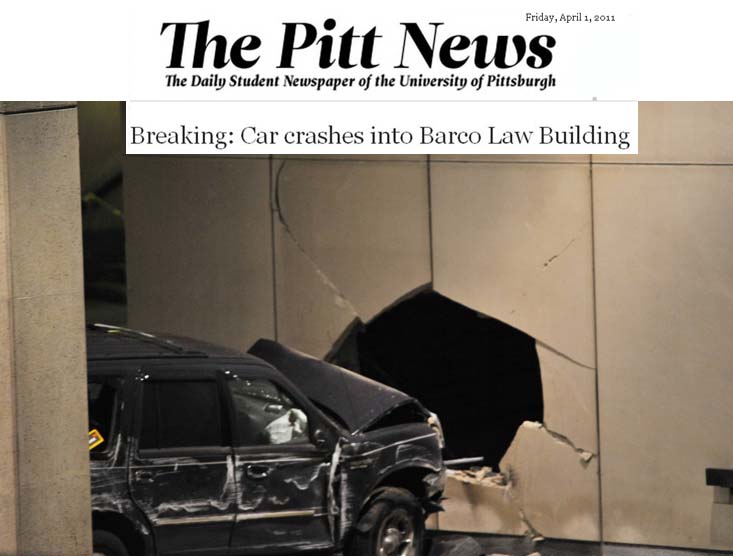
SUV crashes into Moot Court Judges' Chambers

From The Pitt News:
A woman crashed a vehicle into the Barco Law Building yesterday shortly after 10 p.m., leaving her dark Ford SUV embedded in the concrete wall...Witnesses said the vehicle came out of the Towers garage, heading straight toward David Lawrence Hall and the Barco Law Building.The scraps of black plastic left behind made it look as if the woman had driven between two concrete pillars about 15 feet apart, straight through a narrow space between the curve of David Lawrence and another pillar about 10 feet away, and then down the nearby stairs before making impact with the Barco Law Building.
(The woman driving the car) was conscious and alert when paramedics carried her out on a stretcher at about 10:30 p.m...She was taken to UPMC Presbyterian Hospital. Her condition was not made public by midnight last night.

Wednesday, 30 March 2011

New York Times online erects paywall

The New York Times online version, which used to be free, has begun charging subscription fees; the reasoning and the methodology was explained on Monday in a letter to the readers from publisher Arthur Sulzberger Jr. Currently they only have a single-subscriber pricing model available, with various permutations that are explained on their FAQ page.  The Christian Science Monitor (ironically) has a clearer description of the available options as well as discussion of how the move is being viewed by media scholars and others.  

Shpoonkle: eBay for Lawyers

A student at New York Law School has created some waves in the legal establishment by starting a website called Shpoonkle: Justice You Can Afford!.  The site, which has been described as eBay for lawyers, allows lawyers and law firms to bid on legal requests submitted by clients. Lawyers, law students,  and clients looking for a lawyer can register at the site. The Mission of Shpoonkle is "to provide a service that makes it as easy as possible for everyone to find affordable legal representation."  The ABA Journal reports that the legal community's response to the website has been mixed. 

Wednesday, 23 March 2011

So many databases...

So little time. We tend to focus on the major databases for lawyers,  legal scholars and law students that the Barco Law Library provides, but sometimes should remind folks that through the vast collections of both the law library and the University of Pittsburgh Library System we have access to many interesting and random digital collections. For example, reading about Prof. Jessie Allen's blog, Blackstone weekly, reminded me that our quirky LLMC Digital collection contains the whole Yale Blackstone Collection; though not all of it has been digitized yet. Eventually they will get around to digitizing the whole collection.  But meanwhile they have a number of old editions of Blackstone's Commentaries available in pdf format; as well as some American editions, abridgements, parodies, quizzes, and others. It's fun to peruse the collection.  
Also today we learned that Prof. McCarthy had a letter responding to an earlier article on the constitutionality of health reform published in the New York Review of Books. We  quickly pointed out that the article and exchange of correspondence are available via Pitt's electronic NYRB subscription. Pitt has so many electronic resources that it's always a good idea to  check PittCat  for any journal or publication you are interested in reading. 

E-Textbook study

The Chronicle of Higher Education's Wired Campus Blog reports that California State University is running one of the nation’s largest pilot studies of e-textbooks, involving thousands of students, and it seems that whether or not students like digital textbooks depends on the terms  publishers set on how the ebooks can be used.  Usage terms such as whether a student can print the whole book or only a portion of it, or whether the text can be downloaded to a computer or only accessed online, have a strong effect on how students view the ebooks.
The university system has prepared a preliminary report that was first reported last week by Converge Magazine.
The study involved 3,870 students in 30 courses where an e-textbook was assigned. Thousands more students were in a control group of similar courses using traditional textbooks. Of the 662 students who answered a survey after the fall semester about one-third said they were satisfied with the experience, one-third said they were neutral, and one-third said they were dissatisfied.
Students who were assigned e-textbooks were more likely to buy the book than those in courses that required traditional texts, which university officials took as a positive result. In the survey, 73 percent of students in e-textbook courses bought the course material, while only 46 percent of students in traditional courses bought the book. University officials believe that the lower cost of the electronic texts led to the increase.

Tuesday, 22 March 2011

Cornell won't sign nondisclosure agreements with vendors

The Chronicle of Higher Education reports that the Cornell University Library has publicly declared that it won't sign contracts with vendors that require nondisclosure of pricing and terms. The full announcement explains that "To promote openness and fairness among libraries licensing scholarly resources, Cornell University Library will not enter into vendor contracts that require nondisclosure of pricing information or other information that does not constitute a trade secret...In the past, some libraries have tolerated these clauses in the belief that they might result in a lower cost. This, however, is a position that CUL can no longer accept...The more that libraries are able to communicate with one another about vendor offers, the better they are able to weigh the costs and benefits of any individual offer. An open market will result in better licensing terms. Additionally, nondisclosure agreements conflict with the needs of CUL librarians and staff to work openly, collaboratively, and transparently.

SSRN launches Purchase Bound Hard Copy service

SSRN has sent an announcement that the Purchase Bound Hard Copy service is now available. With this service authors and readers can order printed copies of select papers in the SSRN eLibrary. In order to be eligible for this service, a paper must be free, publicly available, and none of the authors have opted-out of the service.

Tip: don't put your weddings photos on Facebook if you're already married to someone else

There is a news story from Grand Rapids, Michigan about Richard Barton Jr., who was arrested for polygamy thanks to incriminating wedding photos posted on Facebook. Apparently he had "unfriended" (or is it "defriended"? Both have been used in the story) his first wife on FB before marrying his second, but didn't get around to a legal divorce. The first wife became suspicious when he unfriended her and started looking for more information by going to the Facebook pages of other friends and relatives - and she found a picture of him getting married to someone else. She then  notified police about the new marriage simply because she did not know what to do; Michigan state police arrested him on felony polygamy charges. According to detectives, Barton is sorry for the pain he's caused. He is quoted as saying "I let love get in the way".

Friday, 18 March 2011

Le droit à l'oubli: do we have a right to expunge our online traces?

In a recent blogpost by Peter Fleischer, Google's Global Privacy Counsel, he discusses the concept of  le Doit a l'Oubli - which translates into something like "The Right to Oblivion" or "The Right to be Forgotten".  This is a growing movement in Europe,  with roots in France, that posits a right for individuals to erase their internet tracks forever. In fact, the European Union is considering proposals to make the EU the first jurisdiction to establish the "right to be forgotten".
  Fleischer says that it's a well-intentioned attempt to give people the right to delete embarrassing stuff or start afresh; but making laws about it is much more complicated. While the notion might sound attractive on some level, the implications of erasing the historical record could have serious unintended consequences.  Fleischer points out that using "privacy" as a justification for censorship now crops up in several different, but related, debates and there are no easy answers.

Earthquakes and Tsunamis: Information Resources

A geology librarian at the University of Illinois has created an excellent quick resource guide of information about earthquakes and tsunamis.
hat tip: Pat Roncevich

Wednesday, 16 March 2011

Farewell, Statistical Abstract

Apparently it's true: the demise of the Census Bureau's Statistical Abstract of the United States is slated for next year.  Rumors first surfaced on the govdocs listerv, and the guys over at the Free Government Information blog have confirmed; they provide a link to the Dept. of Commerce's Budget Justification document (pages 82-92). What is the Stat Ab? A publication of the United States Census Bureau, it's been published annually since 1878 and is the standard summary of statistics on the social, political, and economic organization of the United States. It is also designed to serve as a guide to other statistical publications and sources.  It's one of those reference books that every library keeps at the ref desk because it gets so much use.  The 2011  (130th Edition) Statistical Abstract of the United States, available from the Census Bureau website, contains 30 sections (each section can be downloaded as a separate pdf) and 1,010 pages covering over 200 topics from detailed birth, marriage and death stats to stats on all the bodies of water in the US to banking stats and everything in between.  

Tuesday, 15 March 2011

Solar Table charges your gizmos wirelessly

Inhabitat blog reports that Panasonic recently unveiled a solar table that will charge electronic devices using the solar energy it collects.  According to the blog, the table will be available in late 2011 or early 2012. 

Music Copyright Infringement Project

The old Music Copyright Infringement Project that used to be at the Columbia Law library website has found a new home at UCLA law school. The purpose of the project is to make  information about U.S. music copyright infringement cases universally available, including cases from the mid-ninteenth century forward.  You can listen to the disputed music and read what the courts have to say about the cases. 

LexisNexis Advance for Associates

LexisNexis is continuing their strategy of designing online tools specifically targeted to user types.  The first release they announced is "LexisNexis Advance for Solos", geared to the needs of solo practitioners; you can see an online demo on the LexisNexis website. Now they have announced the upcoming release of "LexisNexis Advance for Associates", geared specially towards law firm associates, who perform much of the legal research in law firms.  Greg Lambert over at 3 Geeks and a Law Blog got a sneak peak at the Associates product and has a lengthy description in his blogpost. 

Friday, 4 March 2011

Uniform Resource Locator news

There's lots of exciting news about the internet every day, but the news isn't usually about Uniform Resource Locators, aka urls.  Urls are the long string of characters -that start with "http" and go on and on -that we type into our browsers to find webpages.  But this week there were 2 interesting stories about urls in the news.
The first is from MIT Technology Review, titled "A Tangled Web of Shortened Links".  The story is about how the unrest in Libya has caused unforseen consequences online, especially on the popular social media platform Twitter, According to the story, when "the Libyan government temporarily cut off access to the Internet within the nation's borders...the goal was to control the flow of information to the public and disrupt coordination among the demonstrators. The shutdown failed to do either, but for a while it threatened to have an odd side effect: impairing the functioning of websites using Libya's ".ly" domains, including the popular service bit.ly, which millions use to turn long Web links into short ones that can be sent out on Twitter." It turns out that  backup domain servers in Oregon and Amsterdam kept bit.ly running through the blackout. But the incident drew attention to the fact that link-shortening services are now used to share huge numbers of links.
The second story is an excellent article on LLRX titled "Breaking Down Link Rot: the Chesapeake Project Legal Information ArchiveLegal Information Archive's Examination of URL Stability".  It reports on a study of link rot, a topic that is of great concern to librarians who are involved in preservation of online digital content. The Chesapeake Project Legal Information Archive is a collaborative law library project of the Georgetown Law Library and the state law libraries of Maryland and Virginia that is preserving web-published law and policy related materials.  The results of the study demonstrate that among the original URLs from which content was harvested for the Chesapeake Project, link rot has increased steadily over time.

Wednesday, 2 March 2011

"Dr. Googleberg" resigns

The BBC reports that German Defence Minister Karl-Thodor zu Guttenberg resigned yesterday after 2 weeks of political pressure following allegations that he plagiarized a large portion of his Doctor of Laws thesis. His thesis, which compared the U.S. Constitution with a proposed EU constitution, had earned him a summa cum laude doctorate from Bayreuth University. However, law professor Andreas Fischer-Lescaro last week alleged that long passages of the thesis had been plagiarized without citation. Once the allegations became public, plagiarism hunters went through the document and say that 20 percent of the 475 page thesis was plagiarized, including a passage copied from a US embassy website and one from a speech by the former president of Stanford University. The allegations earned him the nicknames "Dr. Googleberg" and "Dr. Cut and Paste".
Guttenberg has apologized to the writers he plagiarized and requested the revocation of his degree; Bayreuth University revoked his degree. Guttenberg tried to retain his government position but resigned yesterday under intense public scrutiny of the plagiarism allegations.
The BBC has responded to the scandal with a lengthy article on the plagiarism "boom".

Monday, 28 February 2011

No Laptops in the Classroom

John Mayer of CALI has authored an excellent new blogpost on the subject of Laptop Bans, which is one of those pesky law school topics that just won't go away.  John says "I have long believed that the issue of banning laptops in the classroom is not the real issue, it is instead an indicator of student attention/distraction."  He goes on to unpack the arguments used against the laptops and make a very cogent argument for eliminating lecturing as the main pedagogical method for teaching law. 

Friday, 25 February 2011

Friday Fun: no laptops in class

Walkshed Philly

Walkshed Philly is a great site that provides a map of "walkability" in Philadelphia.  It is a research project of Aaron Ogle, a software developer who lives there. His concept of a "walkshed" scores a location based on the number and quality of amenities that one can walk to within a one-mile radius, things like grocery stores, coffee shops, restaurants, public transportation stops, libraries, hardware stores, etc.The ease of walkability has to do with any barriers that might prevent pedestrians from reaching these amenities. You can set how important each set of amenities is to you on a sliding scale.
There is also a Walkshed map for New York; I've featured Philly because the AALL annual July conference is located there this year.

hat tip: Pat Roncevich

Thursday, 24 February 2011

Boop Oops a Doop

In a 2-1 decision Wednesday, the U.S. Ninth Circuit Court of Appeals upheld a lower court’s ruling that Fleischer Studios Inc., the family of Max Fleischer,  doesn’t have standing to bring a trademark infringement lawsuit against several other companies that license Betty Boop merchandise, including Avela Inc.– because  it was unable to prove the chain of how the rights to the character was transferred over the years. Max Fleischer created Betty Boop in 1930. A decade later he transferred rights to Paramount Pictures. Control over Boop changed hands a few more times in the next 70 years, and it was up to the Fleischer estate to establish a chain of custody that resulted in them reacquiring the character in 1997.  The decision is available online.


Pocket Guide for Federal Judges Discusses Sealed Cases

A recently published pocket guide for federal judges focuses on the occasional need to seal court records and proceedings.  Published by the Federal Judicial Center, the 22-page pocket guide (pdf) draws on the voluminous case law to discuss the process courts use to keep some of the proceedings and records confidential.  The guide states: “Essential to the rule of law is the public performance of the judicial function. On occasion, however, there are good reasons for courts to keep parts of some proceedings confidential . . . Usually that means that any transcript made of the proceeding will be regarded as a sealed record.”  The guide offers a procedural checklist of considerations when a record is sealed or when a proceeding is closed to the public.


Monday, 21 February 2011

HeinOnline Searching 101 Webinar

HeinOnline is offering a free 45 minute webinar on "HeinOnline Searching 101" this Thursday, Feb. 24, at two times: 10 am and 2 pm. You can find out more about the contents of the webinar, and register, on the HeinOnline wiki.  I have attended a number of HeinOnline webinars and can heartily recommend them - they do a really good, clear job of explaining the material.  

New Models for the FDLP

The Government Printing Office has retained Ithaka to develop sustainable models for the Federal Depository Library Program in the 21st century. ead a project that will develop a model for the Federal Depository Library Program (FDLP) to more efficiently accomplish its mission in a rapidly changing digital environment. Both Hillman library and the Barco Law Library are Depository libraries, and so will be impacted by whatever decisions are made about the program.  In the most recent publication from Ithaka, "Draft New Models for the FDLP",  they  lay out a series of new models for the FDLP that  seek to reshape the FDL Program to accommodate local and system-wide strategic shifts that are occurring across the library landscape with the transition to an increasingly digital environment, enabling libraries to more comfortably participate in the Program while maintaining or even increasing broad public access to government information and services to support its effective use. The full document is available as a 24 page pdf, and a Summary of the document is also available. Ithaka is asking for feedback and comments on the proposed new FDLP models.  

Cabell's Directories of Publishing Opportunities

The University Library System has announced a new online database subscription to the Cabell's Directories of Publishing Opportunities for Business and Education are now available online.  These Directories help researchers identify publications most likely to accept their manuscripts by providing information on journals published in select fields.  Information on the topic areas emphasized by each journal, the type of review process, acceptance rate, and number of internal and external reviewers are included. The Directories also include extensive information on manuscript guidelines for each journal and/or indicates the use of a standard set of publication guidelines (such as MLA or APA style) by a journal. Though these directories don't have provide information about legal journals, there may be interest in some of the journals in the areas of Economics, Finance, and Educational Technology & Library Science.


Friday, 18 February 2011

Library of Congress history newpapers update

The Library of Congress reports that 178,000 pages have been added to the Chronicling America historic newspapers project, and that the website has been updated with improved search features and navigation. The ambitious project aims to provide information about and digitize historic newspapers from all across America in an online searchable database. 

Thursday, 17 February 2011

BBC offers information on Middle East protests

The BBC has an online resource that provides country-by-country information on protests occurring in the middle east since the fall of the presidents of Egypt and Tunisia.   

Tuesday, 15 February 2011

NYT reveals some Google "dirty little secrets"

A lengthy article in the New York Times this past Sunday was titled "The Dirty Little Secrets of Search" and should be of interest to anyone in the information biz - or anyone who uses Google to search, for that matter.  The article details how retailer J.C. Penney managed to game the Google system last fall to land at the top of  search results for pretty much anything J.C. Penney sells: dresses, bedding and area rugs; “skinny jeans,” “home decor,” “comforter sets,” furniture, tablecloths, and even grommet top curtains. The New York Times exposes the "sprawling, subterranean world of 'black hat' optimization" (using means that Google considers deceptive, as opposed to "white hat" optimization using methods that are OK with Google.)

Monday, 14 February 2011

Pitt Law grads have Virtual law firm

The Post Gazette has an article today about a pioneering "virtual law firm" specializing in immigration law and international business law.  The firm was founded by 2 recent Pitt Law grads, John Riley and George Ernst, who graduated in 2008 and 2007. With the cooling job climate for new lawyers in Pittsburgh, the two friends decided to start their own firm, specializing in intermational and immigration law. Ernst & Riley bills itself as a virtual law firm that hopes to reach a growing number of people seeking legal services through the Internet. The firm maintains an office in Monroeville, but handles the bulk of its work on a Web portal that allows clients to access information and ongoing updates on their cases.

Sunday, 13 February 2011

CA Supreme Court: stores can't ask for zip code

California's Supreme Court has ruled  unanimously in Pineda v. Wiams Sonoma  (15 page pdf) that retailers don't have the right to ask customers for their ZIP code while completing credit card transactions because doing so violates a cardholders' right to protect  personal information. The court's opinion points to a state law intended to protect consumer privacy by prohibiting retailers from "soliciting and recording information about the card-holder that is unnecessary to the credit card transaction". That includes not only the customer's address and phone number but also information, such as a postal code, that can be used to locate the customer.

Friday, 11 February 2011

Mice trained to detect bombs and drugs

And in another interesting technological development, the New Scientist reports that Israeli scientists have developed a way to train mice to detect would-be bombers and drug carriers in airports. They have created a detector, similar looking to a full-body scanner but with three concealed cartridges each containing eight specially trained mice. The mice work 4-hour shifts during which the mice mill about in a common area in each cartridge as air is passed over people paused in the archway and through the cartridge. When the mice sniff traces of any of eight key explosives in the air, they are conditioned to avoid the scent and flee to a side chamber, triggering an alarm. To avoid false positives, more than one mouse must enter the room at the same time. 

Boston city government developing pothole app

The Boston Globe's boston.com reports that in Boston, the mayor's Office of New Urban Mechanics is working on Street Bump, an application for smartphones that would automatically report potholes to the city's public works department when a car his a bump.  Apparently the GPS in smart phones can be used to identify bumps in the road.
Pittsburgh, sounds like an idea our DPW could use.

Thursday, 10 February 2011

Congressional Quarterly to publish new information service

CQ has announced that it is launching a new subscription service called First Street, an information source for  lobbyists, law firms, associations and other groups working to affect federal government policy. First Street is "a revolutionary database built for researching political relationships and building coalitions." It contains the information in CQ's directories for Congressional staff  and lobbyists, combined with news and information about legislation.  The New York Times describes it as "a Facebook for lobbyists."
The Sunlight Labs blog ( part of the Sunlight Foundation, which has the goal of digitizing government data and making tools and websites to make it easily accessible) points out that much of the information provided by this service is freely available, though subscribers are paying for aggregation and some analysis of the info. 

Wednesday, 9 February 2011

Plans underway for a large print journal repository

The Chronicle of Higher Education's Wired Campus Blog reports that a group of academic libraries in the western US has received a grant to implement plans for a large regional print-journal archives called the Western Regional Storage Trust.  The group includes the University of California libraries, Stanford, Arizona State, the University of Washington, University of Oregon, and western library consortia; the Trust will serve the entire US region west of the Mississippi River. Participating libraries will consolidate print journal backfiles at major library storage facilities and at selected campus locations. The long-term goals for the Trust are to preserve the scholarly print record at the lowest possible cost through a coordinated system of  archives, as well as creating significant freed-up space  in libraries and storage facilities. 

New CALI lesson: Dangerous Dog Laws & Procedural Due Process

CALI has a new lesson called Dangerous Dog Laws and Procedural Due Process.  The  lesson is an introduction to the basics of dangerous dog laws and is the first part in a series of three lessons that examines their interaction with the Fourteenth Amendment's procedural due process requirement. This lesson does not require any prior knowledge of animal laws or dangerous dog laws. While some general knowledge of due process might be helpful, it is not necessary or required.  The lesson is authored by Lauren Gallagher and Ledy VanKavage, two attorneys working for Best Friends Animal Society, a nonprofit, membership organization building no-kill programs and partnerships.  

Tuesday, 8 February 2011

Super WiFi

The New York Times reports that the Federal Communications Commission proposes expanding broadband access to rural areas of the United States, using a new type of wireless network called "super WiFi" that it hopes will become a key part of rural America's infratructure. Unlike regular Wi-Fi networks, which are generally limited to providing high-speed Internet in a house, super Wi-Fi promises to blanket entire neighborhoods with high-speed access. The FCC proposes paying for this by converting the current $8 billion Universal Service Fund, currently used to provide telephone service to underserved areas,  into a new pool of $$  called the Connect America Fund, to be used for helping pay for making broadband available to underserved areas.

FDsys A to Z list

Enterprising govdocs librarian Carolyn Ottoson of West Texas A&M University has kindly shared a resource she created that provides a very useful A to Z list with links to all the online resources available in FDsys, as well as a link to the FDsys Additional Government Documents page. 

Changes in publication of U.S. Gov. Manual

On  Feb. 4, 2011, the Administrative Committee of the Federal Register published updated  regulations affecting publication of the U.S. Government Manual, removing the requirement to publish an annual print edition. According to the FR, the   "ease of online access to an updated version of the Manual, and given the decline in demand for the printed edition, the Administrative Committee, with the approval of the Attorney General, is amending its regulations to remove the requirement to publish an annual edition of the Manual.The Administrative Committee believes that publishing the Manual in a free, electronic-only format to Federal officials for their official use constitutes the distribution of a Federal
Register publication for official use without charge."
Printed copies of the Manual may still be issued and would be available from the U.S. Government Bookstore.
The Manual is the official handbook of the US government, providing comprehensive information on the agencies of all three branches.

Monday, 7 February 2011

ABA unveils new website

The American Bar Association has unveiled a major website redesign, as well as a move from its well-known "old" website URL, abanet.org, to a new URL, americanbar.org.  The ABA President, Stephen Zack, announced the newly designed website,  adding that it provides "improved functionality that offer simpler navigation, better search capabilities and enhanced interactive features".  

"Develop for Privacy Challenge" competition

PC World reports that the new Develop for Privacy Challenge competition - sponsored by branches of the ACLU, the Tor project, and with the assistance of the Ontario Information and Privacy Commission - challenges mobile application developers to create tools that help ordinary mobile device users understand and protect their privacy.  The goal of the contest is explained: "as mobile devices become more sophisticated and handle increasing amounts of sensitive information, individuals need better tools to protect and manage this data. The goal of this Challenge is to demonstrate the possibility that apps for mobile devices can actually enhance the privacy of users. By doing so, we hope not only to generate technology that is useful today, but also to encourage developers and companies to adopt the “privacy by design” mindset so that future devices and technologies will be designed with privacy in mind from the start."
The deadline for submissions is May 31, 2011. Information about the project and how to submit entries can be found at the Develop for Privacy Challenge website. 

Saturday, 5 February 2011

New York Public Library waves the Terrible Towel


On Thursday morning, a Terrible Towel was hoisted high in front of the New York Public Library on Fifth Avenue in Manhattan, as a result of a bet between the mayors of Pittsburgh and New York on the outcome of the Steelers/Jets game. The location was chosen because Pittsburgh industrialist and philanthropist Andrew Carnegie funded the New York Public Library branch system. There is a video of the mayor hanging the towel on YouTube.

Thursday, 3 February 2011

What is @?

This is a hilarious Today spot from 1994 where Bryant Gumbel and Katie Couric wonder what @, .com, and "the internet" are all about.  

Monday, 31 January 2011

U.S. Code Title 51

Thanks to sharp-eyed fellow law librarian Brian Huddleston who noticed that the Lexis interface now shows that  the US Code has a new Title, Title 51, "National and Commercial Space Programs". Title 51 is now included in the Lexis federal collection, along with its 7 Subtitles.  As of this morning it hadn't been added to Westlaw.  The new Title was created by Public Law 111-314, signed by President Obama on Dec. 18. A page further explaining the bill is available from the Office of the Law Revision Counsel (the people who prepare and publish the US Code, where laws are codified by subject matter). 

Friday, 28 January 2011

Judge Posner pans the Bluebook

Judge Richard Posner has published a scathing  review of the latest (19th) edition of the Bluebook (12 page pdf) in the most recent Yale Law Journal. The review begins "Nowadays the word “hypertrophy” is used mainly to denote a class of  diseases in which an organ grows to an abnormal size because of the uncontrolled growth of the cells that constitute it. But the word is still used occasionally to denote a structure or activity that has grown far beyond any apparent functional needThe Bluebook: A Uniform System of Citation exemplifies hypertrophy in the anthropological sense. It is a monstrous growth, remote from the functional need for legal citation forms, that serves obscure needs of the legal culture and its student subculture." 
He goes on to say that the first edition of the Bluebook (26 page pdf, with large font), published in 1926, was just 26 pages long; by the time Judge Posner was in law school in 1958, using the 10th edition, it was 124 pages long; and in the 52 years since it has grown by 400 percent.
If the Bluebook has ever caused you misery you will enjoy this review. 

The history of reading

BigThink has an interesting post entitled "From Papyrus to iPad: The Evolution of Reading" by technology writer Nicholas Carr.  The post consists of a video as well as the transcript of his talk.  He notes that spaces between words were only invented around 800 or 900 AD, before which reading was a more cognitively intensive act. The advent of eReaders threatens to revive this complexity. He says that  reading is again "becomes a more cognitively intensive act, the way it was back when there were no spaces between words. And as a result, I think we begin to lose the ability to read in the deepest, most interpretive ways because were not kind of calming our mind and just focusing on the argument or the story." 

Australian legislation online

The Law Librarians of Congress blog reports on "New and Improved Access to Australian Legislation". ComLaw, the main Australian website for up-to-date Commonwealth legislation, has been revised with major improvements in navigation and linkage to other Australian law websites. 

Prof. Deborah Brake on "Getting in the Game"

Today's edition of Inside Higher Ed. features an in-depth interview with Prof. Deborah Brake on her recent book, Getting in the Game: Title IX and the Women's Sports Revolution, and on Title IX.

Thursday, 27 January 2011

Modeling a Sustainable Federal Depository Library Program

We reported in September that Ithaka has been contracted by the Government Printing Office (GPO) for a project to "develop sustainable models for the FDLP in the 21st century."  Ithaka has already released several draft documents: Background (final draft), Environmental Scan (final draft),  DRAFT White Paper on Existing Library Networks, and a Summary of Research Phase Findings and Implications.  For everyone interested in the FDLP program and/or government documents, the librarians over at Free Gov Info blog have provided a document that contains  the Ithaka  "Findings" document with many thoughtful comments and annotations by the bloggers.

Wednesday, 26 January 2011

Do hawks like to read?

The Library of Congress blog reports that somehow a Cooper's Hawk has flown into the Main Reading Room of the LOC.  The blogger has an excellent sense of humor; no news yet of the hawk's sense of humor. A number of astute commenters have been suggesting names for the Hawk as well as possible ways for luring it out of the LOC.

Monday, 24 January 2011

Is Google losing its edge?

The State of Search blog, written by a group of  websearch  strategists and social media experts, has a recent article called "We're tired of Google, it's time for a change." According to the post Google now takes the role of the lumbering and slow-moving giant of the web, incapable of dealing with the growing mountains of webspam (has anyone else noticed that Google results seem to be getting less satisfying?). The author goes on to discuss Bing, the search engine that Microsoft developed and is pushing, but says that "Bing suffers from nearly all of the issues Google is faced with: cluttered SERPs (that's Search Engine Results Pages ), spammy results, and an image lacking trust and, well, hipness." Instead, he prefers Yandex, a Russian search engine that has, according to the article, "everything that Google has lost over the past 10 years" , as well as some new technology called Spectrum that focuses on allowing the search engine to return a whole “spectrum” of results matching a variety of user intents based on the frequency of user searches and creating categories that become associated with keywords.  

Write your exam anxiety away

There's an interesting article in Science magazine this month titled "Writing About Testing Worries Boosts Exam Performance in the Classroom".  It reports on a study by two psychology professors at the University of Chicago who found that having students write about their test anxiety for ten minutes  before taking a high-stakes exam significantly improved students' exam test scores.
College students were given a challenging math test involving a subject they hadn't encountered before (sounds like a nightmare I've had). Then they learned they'd win $10 if they increased their score on a second test, and that their performance would also determine whether another student got $10. To add to the pressure, they'd be videotaped and their methods evaluated. Before the second test, the students either sat quietly for 10 minutes or wrote about what they were feeling. The nonwriters "choked," the researchers said, with their scores dropping by 12 percentage points. But those who wrote about their anxiety raised their scores by four percentage points. In field studies in real high-school biology classes, students with high test anxiety scored the equivalent of B-plus on a final exam when they did the writing exercise, and B-minus when they didn't.
The authors conclude that a brief expressive writing assignment that occurred immediately before taking an important test, can significantly improve students’ exam scores, especially for students habitually anxious about test taking. Simply writing about one’s worries before a high-stakes exam can boost test scores.

Thursday, 20 January 2011

Vooks

The Wall Street Journal today had an article titled "Not a Book, a 'Vook'". What's a vook?  According to the article, it's an interactive digital book from Vook Inc., a company selling which offers digital books that combine video, text, photos and social sharing. Its Sherlock Holmes vook, for instance, features two classic stories by Sir Arthur Conan Doyle—"The Man with the Twisted Lip" and "The Adventure of the Speckled Band"—and enhances them with videos that delve into the history and legend surrounding the character of Holmes.
According to the Vook website, "A vook is a new innovation in reading that blends a well-written book, high-quality video and the power of the Internet into a single, complete story. You can read your book, watch videos that enhance the story and connect with authors and your friends through social media all on one screen, without switching between platforms."
Vooks are available in two formats: As a web-based application you can read on your computer and as a mobile application for iPhone, iPod touch and iPad for reading on the go.  The company released about 150 titles last year and will publish more than 1,000 vooks this year. Most vooks sell for about $7 but range up to about $16.

Monday, 17 January 2011

Kindle Lending Club

Lifehacker (among other blogs) reports on the Kindle Lending Club, which recently launched. The Lending Club came about because at the end of December Amazon introduced  Kindle lending, which allows you to borrow or lend a book for 14 days. Currently publishers have to enable lending, so not all ebooks are available to be shared.

New music industry law database

Law.com has a story today about a website called The Discography,  an online database of over 2,400 court decisions relating to the music industry that are searchable by artist, case type, location and date. The website was created by Loren Wells, a recent graduate of Washington University in St. Louis School of Law. The site, which he officially launched last month, is supported and underwritten by the Wash U  law school's Center for Empirical Research in the Law.

Friday, 14 January 2011

Wikipedia celebrates 10th anniversary

On Saturday January 15 Wikipedia will celebrate its 10th anniversary.  As Computerworld says, Wikipedia "has become an Internet juggernaut by spreading access to information with a model that lets anyone edit its articles." To celebrate, Wikipedia and its users are planning more than 300 events across six continents and have set up a special webpage called ten.wikipedia.org where event organizers can list information (and yes, there is an event listed for Pittsburgh, on the South Side at the Carson City Saloon).
Wikipedia has also set up a timeline page that lists important events and milestones. Currently there are about 17 million Wikipedia articles, of which about 3.5 million are in English.

ABA may make LSAT optional

The ABA Journal reports that an American Bar Association panel reviewing law school accreditation rules may recommend an end to a requirement that law schools use the Law School Admissions Test. If the panel makes that recommendation and the ABA approves the change then law schools would be able to make the LSAT optional or drop the test requirement entirely. A special report last summer criticized the impact of the U.S. News & World Report rankings that stress high LSAT scores, among other data. Many undergraduate colleges have made the SAT and ACT optional in recent years and generally have found that such shifts attract more applicants and a more diverse applicant pool without leading to any loss in academic performance.

Wednesday, 12 January 2011

JSTOR teams with university presses to publish books online

JSTOR (a non-profit service that is part of the ITHAKA organization) has announced  that it is teaming up with several university presses to expand its catalog to include digital books in its searchable online database. The five university presses currently involved in the project are Chicago, Minnesota, North Carolina, Princeton, and Yale. Books from these presses are expected to be available in 2012. According to the JSTOR press release, “'Books at JSTOR' will make front and back list titles available to libraries around the world in flexible ways that encourage purchase, adoption, and use." JSTOR is already familiar to many of us as an excellent source for digital academic journals and scholarship.
The President of ITHAKA explains that longevity and stability is an important focus of the initiative. “Authors, users, and librarians need to know these books and related work will be available over the very long term.  Preservation is fundamental to our mission and a critical part of what we have worked with the scholarly community to achieve since 1995.” All of the books will be preserved in ITHAKA's Portico digital archive. "Books at JSTOR" will eventually be open to all kinds of publishers, whether non-profit or commercial, so long as the share the collaborative spirit and values of  JSTOR and ITHAKA.

Sudoku app

Slashdot reports on a cool - and slightly scary - feature in the latest version of Google Goggles. If you're having trouble solving a Sudoku puzzle all you have to do is take a picture of it with your cellphone and Google Goggles will solve it for you - there's a YouTube video that demos.

Wednesday, 5 January 2011

Law School Student Engagement Survey results

Both Inside Higher Education and the Chronicle of Higher Education have articles today that report on the just-released 2010 Law School Survey of Student Engagement, conducted at Indiana University at Bloomington's Center for Postsecondary Research.  The survey is based on feedback from nearly 25,000 students at 77 law schools in the United States and Canada, including the University of Pittsburgh School of Law. The articles focus on different aspects of survey results.  Inside Higher Ed's headline is "Law Students in Search of Jobs", and the article highlights survey results showing that most law school graduates last year were dissatisfied with the job placement help they got from their schools. The Chronicle's article is headlined "Law Students, Particularly Women, Have Limited Contact With Faculty, Survey Finds".  The article goes on to talk about disparities between male and female law students, reporting that even though almost half of law students are women, they are less likely to speak up in class or meet with their professors.

Tuesday, 4 January 2011

Ninth Circuit upholds right of blind law grad to use assistive technology on Bar Exam

The Chronicle of Higher Education's Wired Campus blog reports that Stephanie Enyart, a blind graduate of UCLA School of Law, won a legal victory today in her fight to take two legal exams with help from assistive software. Ms. Enyart tried to take the Multistate Professional Responsibility Exam and the Multistate Bar Exam using a computer equipped with assistive technology software known as JAWS
and ZoomText. The State Bar of California had no problem with Ms. Enyart’s request but the National Conference of Bar Examiners refused to approve this particular accommodation (though they did offer other options). She sued under the Americans with Disabilities Act seeking injunctive relief, and a district court ruled that the conference must let her take the exams with the assistive software. Today’s decision, by the U.S. Court of Appeals for the Ninth Circuit, upheld the lower court’s rulings.  A pdf of the Ninth Circuit opinion can be found here.

List of Words Banished from the Queen's English for Mis-use, Over-use and General Uselessness

From Lake Superior State University comes the 2011, 36th  edition of  Words Banished from the Queen's English for Mis-use, Over-use and General Uselessness.  Included on the list:
Adjectives:  fail, viral and epic
Verbs:  refudiate, Facebook and Google
Nouns:  Wow factor, A-Ha moment, and BFF
Other phrases:  Man Up, The American People.

$1 million grant to support new law school in Boise

Concordia University in Portland, Oregon  reports  that they have received a $1 million gift to support their opening of a new law school in Boise, Idaho. Concordia will name their new law library the "George R. White Law Library" to honor Mr. White, the Boise philanthropist who made the gift. Last year, Concordia purchased a 74,000-square-foot LEED gold-rated building in Boise which it is renovating in anticipation of opening Boise’s first law school.
According to the proposed law school's Dean Cathy Silak, "having a private option for legal education in Boise ensures that, no matter the economic condition of the state and the city, there will be a privately funded option, whose program offerings are distinctive from other regional options."
The school will serve 85 students per class. Concordia is expanding to Idaho in part because it has a large number of alumni there. The private, Lutheran liberal arts university formed in 1905 in Northeast Portland and serves 2,500 students.

It's 2011!

The Barconians have just returned from our Winter holiday break and are easing back into working mode.  As a  New Year's first post, we give you Digital Inspiration's "101 Most Useful Websites".  According to blogger Amit Agarwal, all  the sites on this list solve at least one problem really well and they all have simple web addresses (URLs) that you can easily learn by heart thus saving you a trip to Google. We haven't tested all of them yet, but many look like tools we can imagine using during our daily work.
You can also download the list as a PDF eBook and read it anywhere.

hat tip: Digital Inspiration

Wednesday, 22 December 2010

RECOP from Public Resource

From Carl Malamud and Law.Gov (which recently won a million dollar grant from Google for the effort to make all primary legal materials in the United States available to everyone) comes an announcement that in 2011 his project  will begin providing a weekly release of the Report of Current Opinions (RECOP). This will  initially consist of HTML of all slip and final opinions of the appellate and supreme courts of the 50 states and the federal government. The feed will include full star pagination.  It will be treated as an open source project, and will be available for reuse without restriction under a Creative Commons License.
The data is being obtained through an agreement with Fastcase, one of the leading legal information publishers.

Friday, 17 December 2010

George Pike on cybervigilanteism

Barco Law Library Director Prof. George Pike was quoted in an online article on TechNewsWorld.com on The Rise of Cybervigilantism. The article addresses online attacks and counterattacks associated with WikiLeaks, including attacks by Wikileaks supporters on MasterCard and Paypal for declining to accept donations for Wikileaks. In the article, Prof. Pike discusses differences between legal protest and illegal protest activities, and whether such attacks might been as civil disobedience or vigilantism.

Thursday, 16 December 2010

GPO publications available in Google's eBookstore

The Federal Eye blog at the Washington Post reports that hundreds of federal publications from the GPO are available for download through Google's new eBookstore. Plans are for about 1,800 government publications to be available for download and purchase according to the GPO. Currently GPO has about 100 titles in the catalog and will continue to add titles in the next several months, which will include the first volume of the Public Papers of President Barack Obama and the Budget of the United States, Fiscal Year 2012.
And if you are interested in the GPO, you can also subscribe to the GPO's YouTube Channel.

Obama administration calls for 'Bill of Rights' for web privacy

The Wall Street Journal technology blog reports that the Obama administration has recommended the creation of a Privacy Policy Office to develop a "bill of rights" for the internet for US citizens.  The office would also coordinate internet privacy issues globally.  The "bill of rights" would be a framework used to protect citizens from online personal information-gathering and would help the personal data-gathering industry develop codes of conduct that could be enforced by the Federal Trade Commission. These policy recommendations were part of a report released by the Dept. of Commerce Internet Policy Task Force titled Commercial Data Privacy and Innovation in the Internet Economy: A Dynamic Policy Framework (88 page pdf). The Privacy and Information Security Law Blog has posted a summary of the key proposals in the report.

George Pike discusses Federal Trade Commission's Do Not Track proposal

On Tuesday, December 9, Professor and library Director George Pike was a guest panelist on The American Entrepreneur, a radio talk show on Pittsburgh radio station WMNY, Money Talk AM 1360, hosted by Ron Morris. Professor Pike spoke on the Federal Trade Commission’s Do Not Track proposal, released last week. In addition to Prof. Pike and Mr. Morris, the other panelists included John M. Simpson of the public interest group Consumer Watchdog, and Al Polanec, co-principal of Blue Archer, a Pittsburgh web design and marketing company. The broadcast is available online for your listening pleasure.

Tuesday, 14 December 2010

New Books for the Barco Commons Collection

Every year at the end of the first semester we ask our law school faculty for recommendations of books that we can add to our Commons Collection, recreational reading located in the Fawcett Student Commons on the 4th floor of the Barco Law Library.  The list of this year's New Books in the Commons Collection is now available online.

Monday, 13 December 2010

TrueSerials resource comparison tool

Tracy L. Thompson-Przylucki, Executive Director of NELLCO, just tweeted about a cool online resource from TrueSerials called the Resource Comparison.  It lets you compare the content of  up to 4 databases, choosing from a dropdown menu.  For example, you can compare the content of HeinOnline, Legal Trac, and LexisNexis Academic.  Once you choose the databases you want to compare you will get a table showing all the duplicate content in the databases, the content scope and currency.  You can also limit the search to full-text availability.

Online shopping resources

OK, the relationship of this information to legal research is, erm,  tenuous at best.  But many of us are thinking about shopping these days... so this is in the nature of a public service.  :-)  LLRX has a story and guide about ShoppingBots and Online Shopping Resources 2011, providing a "comprehensive listing of shoppingbot and online shopping resources and sites on the Internet."  The list is also available in pdf format. A shoppingbot, in case you are unfamiliar with the term, is a program that searches the Web for the best price for a particular item you wish to purchase; and there are many of them to try. The article on LLRX also provides some tips on virtual shopping to help ensure you have a positive online shopping experience.

Sunday, 12 December 2010

In the wake of WikiLeaks, Pentagon bans removable storage devices

Wired Magazine reports that the U.S. military has issued a directive banning the use of removable media such as USB sticks, CDs, and DVDs on any computer systems or servers.  This comes in the wake of the leak of thousands of diplomatic cables to the whistleblower website WikiLeaks by a 22 year old Army intelligence analyst. According to the Wired story, soldiers are now strictly prohibited from using CDs, DVDs, USB drives and other removable media, at the risk of being court martialed, due to the perceived threat to national security.

Thursday, 9 December 2010

Atlantic Monthly: How to Think About WikiLeaks

The online Atlantic has a blogpost by editor Alexis Madrigal called "How to Think About WikiLeaks". Despite the title, the post doesn't tell you what to think about WikiLeaks - rather, it recognizes the importance of how the WikiLeaks situation plays out, and the difficulty of forming an opinion. And so what the Atlantic is doing is helping us figure out HOW to think about WikiLeaks by gathering the thoughts of many eloquent thinkers/writers. As Mr. Madrigal says, "Writers pulling at the knot of press freedom, liberty, nationalism, secrecy and security that sits at the center of the debate have produced dozens of fantastic pieces. We're collecting the very best here. This page will be updated often."

Update: Jonathan Zittrain has an article posted on  Technology Review titled "Everything You Need to Know about Wikileaks."

Tuesday, 7 December 2010

Mega datasets

The MIT Technology Review has gathered together 70 databases that contain large datasets of various types of information about the world we live in: social science data, climate data, financial data, urban data, scientific data, traffic data, and others. It includes familiar datasets like Wikipedia, the Wayback Machine, and Google Maps as well as lesser knowns like the Global Urban Observatory, the National Household Travel Survey, and Gapminder World, which contains multiple datasets on diverse socio-economic indicators.
A good resource for empirical researchers to bookmark.

Legislation introduced for Wi-Fi in federal buildings

Sens. Olympia Snowe (Maine) and Mark Warner (Va.) have introduced legislation that would require all public federal buildings to install WiFi base stations in order to free up cell phone networks. The Federal Wi-Net Act  (6 page pdf) (S. 3995) doesn't say anything about free access, but it would "direct the Administrator of the General Services Administration to installWi-Fi hotspots and wireless neutral host systems in all Federal buildingsin order to improve in-building wireless communications coverage andcommercial network capacity by offloading wireless traffic onto wirelinebroadband networks".

ps  If you look at the pdf, note the certification that is now appended to indicate that it is authoritative and the Signature properties.

Future of Interface Design on LawLibCon

This week on Law Library Conversations: a discussion of the Future of Interface Design for legal information products. The show will feature Jason Wilson, Vice President Jones McClure Publishing; Ed Walters, CEO, Fastcase; and Tom Boone, Reference Librarian, Loyola Law School. The online, one hour broadcast is on Fri Dec 10 at 3:00 pm Eastern time. The show is hosted and supported by CALI.   You can register here.

Friday, 3 December 2010

Report on "Don't Ask, Don't Tell"

The Department of Defense has posted the Nov. 30, 2010  "Report of the Comprehensive Review of the Issues Associated with a Repeal of 'Don't Ask Don't Tell'" (264 page pdf) on the DOD website.

Sundown for GPO Access

LLRX has some excellent information about the migration of information from GPO Access to FDsys. The GPO Access website is set to ‘sundown’ in late December, as all of the data has been migrated onto the FDsys platform. FDSys offers greater functionality than GPO Access, including the ability to search across multiple collections with keyword searches and more sophisticated search options..  The information on LLRX is from a recent presentation by Ashley Dahlen - Outreach Librarian at the U.S. Government Printing Office.  It includes a video of her presentation, a link to her comprehensive handout (10 page pdf) and a downloadable powerpoint presentation with lots of useful information including a table comparing GPO Access with FDsys. She also reminds us that Federal Depository Libraries like Barco should start planning for the following:
 Replacing uses of the GPO Access name and logo to the FDsys branding.
 Updating screenshots of GPO Access pages to reflect the FDsys pages.
 Ordering the new promotional brochures.

LexisNexis acquires State Net

On Wednesday LexisNexis announced the acquisition of State Net, a database that tracks legislation and regulations in all 50 US states and the District of Columbia.  According to the press release, "State Net provides users access to information on individual legislative bills and their progress within twenty-four hours of public availability. It also enables subscribers to obtain current versions of bills and statutes, check the validity of statutes, track pending changes to statutes and regulations, and research historical summaries of legislative actions. State Net tools and content enable users to assess the impact of proposed legislation and regulations, influence proposed matters, and reduce compliance risk... This acquisition will enable LexisNexis to improve upon them with the addition of primary law content and integration into its offerings for the US legal, business, government and academic markets."  The website has conveniently formatted information about legislative calendars for the states and a variety of online tools for users.

hat tip: Law Librarian Blog

Adopt a Word from the Oxford English Dictionary

'Tis the Season of giving and generosity, and the Oxford English Dictionary is asking friends and admirers to open their hearts and Adopt-A-Word.  The Save the Words campaign has an excellent website where you can choose from  lots and lots of hopeful adoptees. You're sure to find a word you love, though some may misqueme* you.  According to the site, "Each year hundreds of words are dropped from the English language.  Old words, Wise words, hard-working words.  Words that once led meaningful lives but now lie unused, unloved and unwanted.  You can change all that Help save the words!" You can select a word randomly or choose a specific word that you want to adopt.  When you adopt your word (or words) you must pledge to "use this word, in conversation and correspondence, as frequently as possible to the very best of my ability."

*misqueme: v. to displease

Wednesday, 1 December 2010

Free OCLC webinar: Intro to Digital Preservation

OCLC is offering librarians a free 2-hour online webinar called "An Introduction to Digital Preservation" on Weds. Dec. 15 at 1 pm. From the description on the website: "Digital preservation is a phrase that is thrown about frequently in the archives and library world. And responsibility for saving our era from being known as the "Digital Dark Age" has fallen to us. But do you really understand what it means and is required to preserve digital objects? Join us for this 2-hour online webinar for an introduction to terms, concepts, and some methods for beginning your institution’s foray into this important and challenging area." You can register for the webinar here.

LexisNexis sells databases to ProQuest

Yesterday ProQuest announced that they have acquired some of LexisNexis's most popular databases. ProQuest, based in Ann Arbor, MI,  says it is excited to announce that it  is significantly expanding its service.  Though LexisNexis doesn't have any info on its website, a quote from the ProQuest press release says“As LexisNexis continues to transform its portfolio of products and services, we are very pleased to place this business unit with ProQuest as it is an excellent fit for them and their customers,” said Mike Simmons, senior vice president of Specialty Businesses at LexisNexis. “We look forward to working with ProQuest – including licensing back certain legislative content sets from ProQuest for our legal professional customers.”
ProQuest has acquired the following LexisNexis products:
LexisNexis Congressional (to be renamed ProQuest Congressional)
LexisNexis Statistical Insight (to be renamed ProQuest Statistical Insight)
LexisNexis DataSets (to be renamed ProQuest DataSets)
LexisNexis Statutes at Large (to be renamed ProQuest Statutes at Large)
LexisNexis Government Periodical Index (to be renamed ProQuest Government Periodical Index)
LexisNexis Primary Sources in US History (to be renamed ProQuest Primary Sources in US History)
Congressional Hearings Digital Collection
Congressional Record Permanent Digital Collection
Congressional Research Digital Collection
US Serial Set Digital Collection
US Serial Set Maps Collection
All CIS microform and print products
All statistical microform and print products
All UPA microform collections
LexisNexis is retaining these academic-oriented products:
LexisNexis Academic
LexisNexis Library Express
LexisNexis Scholastic
LexisNexis State Capital
LexisNexis for Development Professionals

OK law says executors control social media accounts after death

The ABA Journal reports that an Oklahoma law that went into effect Nov. 1 grants estate executors control over a dead person's social media accounts such as Facebook and MySpace.  This law assumes that a social network account is the property of the person who creates it and uses it, even though most social networking websites claim that information as their own when users sign up.

Monday, 29 November 2010

Index to Legal Periodicals Retrospective database

In case you've missed it, we're happy to announce that the problems we've been having with the Index to Legal Periodicals Retrospective database have been solved and it is now up and running smoothly. This retrospective database, from H.W. Wilson, indexes over 750 legal periodicals published in the United States, Canada, Great Britain, Ireland, Australia and New Zealand (you can see the full list of journals, including the dates available, here). Annual surveys of the laws of a jurisdiction, annual surveys of the federal courts, yearbooks, annual institutes, and annual reviews of the work in a given field or on a given topic will also be covered (according to the Wilson blurb).