Friday, 25 February 2011

Walkshed Philly

Walkshed Philly is a great site that provides a map of "walkability" in Philadelphia.  It is a research project of Aaron Ogle, a software developer who lives there. His concept of a "walkshed" scores a location based on the number and quality of amenities that one can walk to within a one-mile radius, things like grocery stores, coffee shops, restaurants, public transportation stops, libraries, hardware stores, etc.The ease of walkability has to do with any barriers that might prevent pedestrians from reaching these amenities. You can set how important each set of amenities is to you on a sliding scale.
There is also a Walkshed map for New York; I've featured Philly because the AALL annual July conference is located there this year.

hat tip: Pat Roncevich

Thursday, 24 February 2011

Boop Oops a Doop

In a 2-1 decision Wednesday, the U.S. Ninth Circuit Court of Appeals upheld a lower court’s ruling that Fleischer Studios Inc., the family of Max Fleischer,  doesn’t have standing to bring a trademark infringement lawsuit against several other companies that license Betty Boop merchandise, including Avela Inc.– because  it was unable to prove the chain of how the rights to the character was transferred over the years. Max Fleischer created Betty Boop in 1930. A decade later he transferred rights to Paramount Pictures. Control over Boop changed hands a few more times in the next 70 years, and it was up to the Fleischer estate to establish a chain of custody that resulted in them reacquiring the character in 1997.  The decision is available online.


Pocket Guide for Federal Judges Discusses Sealed Cases

A recently published pocket guide for federal judges focuses on the occasional need to seal court records and proceedings.  Published by the Federal Judicial Center, the 22-page pocket guide (pdf) draws on the voluminous case law to discuss the process courts use to keep some of the proceedings and records confidential.  The guide states: “Essential to the rule of law is the public performance of the judicial function. On occasion, however, there are good reasons for courts to keep parts of some proceedings confidential . . . Usually that means that any transcript made of the proceeding will be regarded as a sealed record.”  The guide offers a procedural checklist of considerations when a record is sealed or when a proceeding is closed to the public.


Monday, 21 February 2011

HeinOnline Searching 101 Webinar

HeinOnline is offering a free 45 minute webinar on "HeinOnline Searching 101" this Thursday, Feb. 24, at two times: 10 am and 2 pm. You can find out more about the contents of the webinar, and register, on the HeinOnline wiki.  I have attended a number of HeinOnline webinars and can heartily recommend them - they do a really good, clear job of explaining the material.  

New Models for the FDLP

The Government Printing Office has retained Ithaka to develop sustainable models for the Federal Depository Library Program in the 21st century. ead a project that will develop a model for the Federal Depository Library Program (FDLP) to more efficiently accomplish its mission in a rapidly changing digital environment. Both Hillman library and the Barco Law Library are Depository libraries, and so will be impacted by whatever decisions are made about the program.  In the most recent publication from Ithaka, "Draft New Models for the FDLP",  they  lay out a series of new models for the FDLP that  seek to reshape the FDL Program to accommodate local and system-wide strategic shifts that are occurring across the library landscape with the transition to an increasingly digital environment, enabling libraries to more comfortably participate in the Program while maintaining or even increasing broad public access to government information and services to support its effective use. The full document is available as a 24 page pdf, and a Summary of the document is also available. Ithaka is asking for feedback and comments on the proposed new FDLP models.  

Cabell's Directories of Publishing Opportunities

The University Library System has announced a new online database subscription to the Cabell's Directories of Publishing Opportunities for Business and Education are now available online.  These Directories help researchers identify publications most likely to accept their manuscripts by providing information on journals published in select fields.  Information on the topic areas emphasized by each journal, the type of review process, acceptance rate, and number of internal and external reviewers are included. The Directories also include extensive information on manuscript guidelines for each journal and/or indicates the use of a standard set of publication guidelines (such as MLA or APA style) by a journal. Though these directories don't have provide information about legal journals, there may be interest in some of the journals in the areas of Economics, Finance, and Educational Technology & Library Science.


Friday, 18 February 2011

Library of Congress history newpapers update

The Library of Congress reports that 178,000 pages have been added to the Chronicling America historic newspapers project, and that the website has been updated with improved search features and navigation. The ambitious project aims to provide information about and digitize historic newspapers from all across America in an online searchable database. 

Thursday, 17 February 2011

BBC offers information on Middle East protests

The BBC has an online resource that provides country-by-country information on protests occurring in the middle east since the fall of the presidents of Egypt and Tunisia.   

Tuesday, 15 February 2011

NYT reveals some Google "dirty little secrets"

A lengthy article in the New York Times this past Sunday was titled "The Dirty Little Secrets of Search" and should be of interest to anyone in the information biz - or anyone who uses Google to search, for that matter.  The article details how retailer J.C. Penney managed to game the Google system last fall to land at the top of  search results for pretty much anything J.C. Penney sells: dresses, bedding and area rugs; “skinny jeans,” “home decor,” “comforter sets,” furniture, tablecloths, and even grommet top curtains. The New York Times exposes the "sprawling, subterranean world of 'black hat' optimization" (using means that Google considers deceptive, as opposed to "white hat" optimization using methods that are OK with Google.)

Monday, 14 February 2011

Pitt Law grads have Virtual law firm

The Post Gazette has an article today about a pioneering "virtual law firm" specializing in immigration law and international business law.  The firm was founded by 2 recent Pitt Law grads, John Riley and George Ernst, who graduated in 2008 and 2007. With the cooling job climate for new lawyers in Pittsburgh, the two friends decided to start their own firm, specializing in intermational and immigration law. Ernst & Riley bills itself as a virtual law firm that hopes to reach a growing number of people seeking legal services through the Internet. The firm maintains an office in Monroeville, but handles the bulk of its work on a Web portal that allows clients to access information and ongoing updates on their cases.

Sunday, 13 February 2011

CA Supreme Court: stores can't ask for zip code

California's Supreme Court has ruled  unanimously in Pineda v. Wiams Sonoma  (15 page pdf) that retailers don't have the right to ask customers for their ZIP code while completing credit card transactions because doing so violates a cardholders' right to protect  personal information. The court's opinion points to a state law intended to protect consumer privacy by prohibiting retailers from "soliciting and recording information about the card-holder that is unnecessary to the credit card transaction". That includes not only the customer's address and phone number but also information, such as a postal code, that can be used to locate the customer.

Friday, 11 February 2011

Mice trained to detect bombs and drugs

And in another interesting technological development, the New Scientist reports that Israeli scientists have developed a way to train mice to detect would-be bombers and drug carriers in airports. They have created a detector, similar looking to a full-body scanner but with three concealed cartridges each containing eight specially trained mice. The mice work 4-hour shifts during which the mice mill about in a common area in each cartridge as air is passed over people paused in the archway and through the cartridge. When the mice sniff traces of any of eight key explosives in the air, they are conditioned to avoid the scent and flee to a side chamber, triggering an alarm. To avoid false positives, more than one mouse must enter the room at the same time. 

Boston city government developing pothole app

The Boston Globe's boston.com reports that in Boston, the mayor's Office of New Urban Mechanics is working on Street Bump, an application for smartphones that would automatically report potholes to the city's public works department when a car his a bump.  Apparently the GPS in smart phones can be used to identify bumps in the road.
Pittsburgh, sounds like an idea our DPW could use.

Thursday, 10 February 2011

Congressional Quarterly to publish new information service

CQ has announced that it is launching a new subscription service called First Street, an information source for  lobbyists, law firms, associations and other groups working to affect federal government policy. First Street is "a revolutionary database built for researching political relationships and building coalitions." It contains the information in CQ's directories for Congressional staff  and lobbyists, combined with news and information about legislation.  The New York Times describes it as "a Facebook for lobbyists."
The Sunlight Labs blog ( part of the Sunlight Foundation, which has the goal of digitizing government data and making tools and websites to make it easily accessible) points out that much of the information provided by this service is freely available, though subscribers are paying for aggregation and some analysis of the info. 

Wednesday, 9 February 2011

Plans underway for a large print journal repository

The Chronicle of Higher Education's Wired Campus Blog reports that a group of academic libraries in the western US has received a grant to implement plans for a large regional print-journal archives called the Western Regional Storage Trust.  The group includes the University of California libraries, Stanford, Arizona State, the University of Washington, University of Oregon, and western library consortia; the Trust will serve the entire US region west of the Mississippi River. Participating libraries will consolidate print journal backfiles at major library storage facilities and at selected campus locations. The long-term goals for the Trust are to preserve the scholarly print record at the lowest possible cost through a coordinated system of  archives, as well as creating significant freed-up space  in libraries and storage facilities. 

New CALI lesson: Dangerous Dog Laws & Procedural Due Process

CALI has a new lesson called Dangerous Dog Laws and Procedural Due Process.  The  lesson is an introduction to the basics of dangerous dog laws and is the first part in a series of three lessons that examines their interaction with the Fourteenth Amendment's procedural due process requirement. This lesson does not require any prior knowledge of animal laws or dangerous dog laws. While some general knowledge of due process might be helpful, it is not necessary or required.  The lesson is authored by Lauren Gallagher and Ledy VanKavage, two attorneys working for Best Friends Animal Society, a nonprofit, membership organization building no-kill programs and partnerships.  

Tuesday, 8 February 2011

Super WiFi

The New York Times reports that the Federal Communications Commission proposes expanding broadband access to rural areas of the United States, using a new type of wireless network called "super WiFi" that it hopes will become a key part of rural America's infratructure. Unlike regular Wi-Fi networks, which are generally limited to providing high-speed Internet in a house, super Wi-Fi promises to blanket entire neighborhoods with high-speed access. The FCC proposes paying for this by converting the current $8 billion Universal Service Fund, currently used to provide telephone service to underserved areas,  into a new pool of $$  called the Connect America Fund, to be used for helping pay for making broadband available to underserved areas.

FDsys A to Z list

Enterprising govdocs librarian Carolyn Ottoson of West Texas A&M University has kindly shared a resource she created that provides a very useful A to Z list with links to all the online resources available in FDsys, as well as a link to the FDsys Additional Government Documents page. 

Changes in publication of U.S. Gov. Manual

On  Feb. 4, 2011, the Administrative Committee of the Federal Register published updated  regulations affecting publication of the U.S. Government Manual, removing the requirement to publish an annual print edition. According to the FR, the   "ease of online access to an updated version of the Manual, and given the decline in demand for the printed edition, the Administrative Committee, with the approval of the Attorney General, is amending its regulations to remove the requirement to publish an annual edition of the Manual.The Administrative Committee believes that publishing the Manual in a free, electronic-only format to Federal officials for their official use constitutes the distribution of a Federal
Register publication for official use without charge."
Printed copies of the Manual may still be issued and would be available from the U.S. Government Bookstore.
The Manual is the official handbook of the US government, providing comprehensive information on the agencies of all three branches.

Monday, 7 February 2011

ABA unveils new website

The American Bar Association has unveiled a major website redesign, as well as a move from its well-known "old" website URL, abanet.org, to a new URL, americanbar.org.  The ABA President, Stephen Zack, announced the newly designed website,  adding that it provides "improved functionality that offer simpler navigation, better search capabilities and enhanced interactive features".  

"Develop for Privacy Challenge" competition

PC World reports that the new Develop for Privacy Challenge competition - sponsored by branches of the ACLU, the Tor project, and with the assistance of the Ontario Information and Privacy Commission - challenges mobile application developers to create tools that help ordinary mobile device users understand and protect their privacy.  The goal of the contest is explained: "as mobile devices become more sophisticated and handle increasing amounts of sensitive information, individuals need better tools to protect and manage this data. The goal of this Challenge is to demonstrate the possibility that apps for mobile devices can actually enhance the privacy of users. By doing so, we hope not only to generate technology that is useful today, but also to encourage developers and companies to adopt the “privacy by design” mindset so that future devices and technologies will be designed with privacy in mind from the start."
The deadline for submissions is May 31, 2011. Information about the project and how to submit entries can be found at the Develop for Privacy Challenge website. 

Saturday, 5 February 2011

New York Public Library waves the Terrible Towel


On Thursday morning, a Terrible Towel was hoisted high in front of the New York Public Library on Fifth Avenue in Manhattan, as a result of a bet between the mayors of Pittsburgh and New York on the outcome of the Steelers/Jets game. The location was chosen because Pittsburgh industrialist and philanthropist Andrew Carnegie funded the New York Public Library branch system. There is a video of the mayor hanging the towel on YouTube.

Thursday, 3 February 2011

What is @?

This is a hilarious Today spot from 1994 where Bryant Gumbel and Katie Couric wonder what @, .com, and "the internet" are all about.  

Monday, 31 January 2011

U.S. Code Title 51

Thanks to sharp-eyed fellow law librarian Brian Huddleston who noticed that the Lexis interface now shows that  the US Code has a new Title, Title 51, "National and Commercial Space Programs". Title 51 is now included in the Lexis federal collection, along with its 7 Subtitles.  As of this morning it hadn't been added to Westlaw.  The new Title was created by Public Law 111-314, signed by President Obama on Dec. 18. A page further explaining the bill is available from the Office of the Law Revision Counsel (the people who prepare and publish the US Code, where laws are codified by subject matter). 

Friday, 28 January 2011

Judge Posner pans the Bluebook

Judge Richard Posner has published a scathing  review of the latest (19th) edition of the Bluebook (12 page pdf) in the most recent Yale Law Journal. The review begins "Nowadays the word “hypertrophy” is used mainly to denote a class of  diseases in which an organ grows to an abnormal size because of the uncontrolled growth of the cells that constitute it. But the word is still used occasionally to denote a structure or activity that has grown far beyond any apparent functional needThe Bluebook: A Uniform System of Citation exemplifies hypertrophy in the anthropological sense. It is a monstrous growth, remote from the functional need for legal citation forms, that serves obscure needs of the legal culture and its student subculture." 
He goes on to say that the first edition of the Bluebook (26 page pdf, with large font), published in 1926, was just 26 pages long; by the time Judge Posner was in law school in 1958, using the 10th edition, it was 124 pages long; and in the 52 years since it has grown by 400 percent.
If the Bluebook has ever caused you misery you will enjoy this review. 

The history of reading

BigThink has an interesting post entitled "From Papyrus to iPad: The Evolution of Reading" by technology writer Nicholas Carr.  The post consists of a video as well as the transcript of his talk.  He notes that spaces between words were only invented around 800 or 900 AD, before which reading was a more cognitively intensive act. The advent of eReaders threatens to revive this complexity. He says that  reading is again "becomes a more cognitively intensive act, the way it was back when there were no spaces between words. And as a result, I think we begin to lose the ability to read in the deepest, most interpretive ways because were not kind of calming our mind and just focusing on the argument or the story." 

Australian legislation online

The Law Librarians of Congress blog reports on "New and Improved Access to Australian Legislation". ComLaw, the main Australian website for up-to-date Commonwealth legislation, has been revised with major improvements in navigation and linkage to other Australian law websites. 

Prof. Deborah Brake on "Getting in the Game"

Today's edition of Inside Higher Ed. features an in-depth interview with Prof. Deborah Brake on her recent book, Getting in the Game: Title IX and the Women's Sports Revolution, and on Title IX.

Thursday, 27 January 2011

Modeling a Sustainable Federal Depository Library Program

We reported in September that Ithaka has been contracted by the Government Printing Office (GPO) for a project to "develop sustainable models for the FDLP in the 21st century."  Ithaka has already released several draft documents: Background (final draft), Environmental Scan (final draft),  DRAFT White Paper on Existing Library Networks, and a Summary of Research Phase Findings and Implications.  For everyone interested in the FDLP program and/or government documents, the librarians over at Free Gov Info blog have provided a document that contains  the Ithaka  "Findings" document with many thoughtful comments and annotations by the bloggers.

Wednesday, 26 January 2011

Do hawks like to read?

The Library of Congress blog reports that somehow a Cooper's Hawk has flown into the Main Reading Room of the LOC.  The blogger has an excellent sense of humor; no news yet of the hawk's sense of humor. A number of astute commenters have been suggesting names for the Hawk as well as possible ways for luring it out of the LOC.

Monday, 24 January 2011

Is Google losing its edge?

The State of Search blog, written by a group of  websearch  strategists and social media experts, has a recent article called "We're tired of Google, it's time for a change." According to the post Google now takes the role of the lumbering and slow-moving giant of the web, incapable of dealing with the growing mountains of webspam (has anyone else noticed that Google results seem to be getting less satisfying?). The author goes on to discuss Bing, the search engine that Microsoft developed and is pushing, but says that "Bing suffers from nearly all of the issues Google is faced with: cluttered SERPs (that's Search Engine Results Pages ), spammy results, and an image lacking trust and, well, hipness." Instead, he prefers Yandex, a Russian search engine that has, according to the article, "everything that Google has lost over the past 10 years" , as well as some new technology called Spectrum that focuses on allowing the search engine to return a whole “spectrum” of results matching a variety of user intents based on the frequency of user searches and creating categories that become associated with keywords.  

Write your exam anxiety away

There's an interesting article in Science magazine this month titled "Writing About Testing Worries Boosts Exam Performance in the Classroom".  It reports on a study by two psychology professors at the University of Chicago who found that having students write about their test anxiety for ten minutes  before taking a high-stakes exam significantly improved students' exam test scores.
College students were given a challenging math test involving a subject they hadn't encountered before (sounds like a nightmare I've had). Then they learned they'd win $10 if they increased their score on a second test, and that their performance would also determine whether another student got $10. To add to the pressure, they'd be videotaped and their methods evaluated. Before the second test, the students either sat quietly for 10 minutes or wrote about what they were feeling. The nonwriters "choked," the researchers said, with their scores dropping by 12 percentage points. But those who wrote about their anxiety raised their scores by four percentage points. In field studies in real high-school biology classes, students with high test anxiety scored the equivalent of B-plus on a final exam when they did the writing exercise, and B-minus when they didn't.
The authors conclude that a brief expressive writing assignment that occurred immediately before taking an important test, can significantly improve students’ exam scores, especially for students habitually anxious about test taking. Simply writing about one’s worries before a high-stakes exam can boost test scores.

Thursday, 20 January 2011

Vooks

The Wall Street Journal today had an article titled "Not a Book, a 'Vook'". What's a vook?  According to the article, it's an interactive digital book from Vook Inc., a company selling which offers digital books that combine video, text, photos and social sharing. Its Sherlock Holmes vook, for instance, features two classic stories by Sir Arthur Conan Doyle—"The Man with the Twisted Lip" and "The Adventure of the Speckled Band"—and enhances them with videos that delve into the history and legend surrounding the character of Holmes.
According to the Vook website, "A vook is a new innovation in reading that blends a well-written book, high-quality video and the power of the Internet into a single, complete story. You can read your book, watch videos that enhance the story and connect with authors and your friends through social media all on one screen, without switching between platforms."
Vooks are available in two formats: As a web-based application you can read on your computer and as a mobile application for iPhone, iPod touch and iPad for reading on the go.  The company released about 150 titles last year and will publish more than 1,000 vooks this year. Most vooks sell for about $7 but range up to about $16.

Monday, 17 January 2011

Kindle Lending Club

Lifehacker (among other blogs) reports on the Kindle Lending Club, which recently launched. The Lending Club came about because at the end of December Amazon introduced  Kindle lending, which allows you to borrow or lend a book for 14 days. Currently publishers have to enable lending, so not all ebooks are available to be shared.

New music industry law database

Law.com has a story today about a website called The Discography,  an online database of over 2,400 court decisions relating to the music industry that are searchable by artist, case type, location and date. The website was created by Loren Wells, a recent graduate of Washington University in St. Louis School of Law. The site, which he officially launched last month, is supported and underwritten by the Wash U  law school's Center for Empirical Research in the Law.

Friday, 14 January 2011

Wikipedia celebrates 10th anniversary

On Saturday January 15 Wikipedia will celebrate its 10th anniversary.  As Computerworld says, Wikipedia "has become an Internet juggernaut by spreading access to information with a model that lets anyone edit its articles." To celebrate, Wikipedia and its users are planning more than 300 events across six continents and have set up a special webpage called ten.wikipedia.org where event organizers can list information (and yes, there is an event listed for Pittsburgh, on the South Side at the Carson City Saloon).
Wikipedia has also set up a timeline page that lists important events and milestones. Currently there are about 17 million Wikipedia articles, of which about 3.5 million are in English.

ABA may make LSAT optional

The ABA Journal reports that an American Bar Association panel reviewing law school accreditation rules may recommend an end to a requirement that law schools use the Law School Admissions Test. If the panel makes that recommendation and the ABA approves the change then law schools would be able to make the LSAT optional or drop the test requirement entirely. A special report last summer criticized the impact of the U.S. News & World Report rankings that stress high LSAT scores, among other data. Many undergraduate colleges have made the SAT and ACT optional in recent years and generally have found that such shifts attract more applicants and a more diverse applicant pool without leading to any loss in academic performance.

Wednesday, 12 January 2011

JSTOR teams with university presses to publish books online

JSTOR (a non-profit service that is part of the ITHAKA organization) has announced  that it is teaming up with several university presses to expand its catalog to include digital books in its searchable online database. The five university presses currently involved in the project are Chicago, Minnesota, North Carolina, Princeton, and Yale. Books from these presses are expected to be available in 2012. According to the JSTOR press release, “'Books at JSTOR' will make front and back list titles available to libraries around the world in flexible ways that encourage purchase, adoption, and use." JSTOR is already familiar to many of us as an excellent source for digital academic journals and scholarship.
The President of ITHAKA explains that longevity and stability is an important focus of the initiative. “Authors, users, and librarians need to know these books and related work will be available over the very long term.  Preservation is fundamental to our mission and a critical part of what we have worked with the scholarly community to achieve since 1995.” All of the books will be preserved in ITHAKA's Portico digital archive. "Books at JSTOR" will eventually be open to all kinds of publishers, whether non-profit or commercial, so long as the share the collaborative spirit and values of  JSTOR and ITHAKA.

Sudoku app

Slashdot reports on a cool - and slightly scary - feature in the latest version of Google Goggles. If you're having trouble solving a Sudoku puzzle all you have to do is take a picture of it with your cellphone and Google Goggles will solve it for you - there's a YouTube video that demos.

Wednesday, 5 January 2011

Law School Student Engagement Survey results

Both Inside Higher Education and the Chronicle of Higher Education have articles today that report on the just-released 2010 Law School Survey of Student Engagement, conducted at Indiana University at Bloomington's Center for Postsecondary Research.  The survey is based on feedback from nearly 25,000 students at 77 law schools in the United States and Canada, including the University of Pittsburgh School of Law. The articles focus on different aspects of survey results.  Inside Higher Ed's headline is "Law Students in Search of Jobs", and the article highlights survey results showing that most law school graduates last year were dissatisfied with the job placement help they got from their schools. The Chronicle's article is headlined "Law Students, Particularly Women, Have Limited Contact With Faculty, Survey Finds".  The article goes on to talk about disparities between male and female law students, reporting that even though almost half of law students are women, they are less likely to speak up in class or meet with their professors.

Tuesday, 4 January 2011

Ninth Circuit upholds right of blind law grad to use assistive technology on Bar Exam

The Chronicle of Higher Education's Wired Campus blog reports that Stephanie Enyart, a blind graduate of UCLA School of Law, won a legal victory today in her fight to take two legal exams with help from assistive software. Ms. Enyart tried to take the Multistate Professional Responsibility Exam and the Multistate Bar Exam using a computer equipped with assistive technology software known as JAWS
and ZoomText. The State Bar of California had no problem with Ms. Enyart’s request but the National Conference of Bar Examiners refused to approve this particular accommodation (though they did offer other options). She sued under the Americans with Disabilities Act seeking injunctive relief, and a district court ruled that the conference must let her take the exams with the assistive software. Today’s decision, by the U.S. Court of Appeals for the Ninth Circuit, upheld the lower court’s rulings.  A pdf of the Ninth Circuit opinion can be found here.

List of Words Banished from the Queen's English for Mis-use, Over-use and General Uselessness

From Lake Superior State University comes the 2011, 36th  edition of  Words Banished from the Queen's English for Mis-use, Over-use and General Uselessness.  Included on the list:
Adjectives:  fail, viral and epic
Verbs:  refudiate, Facebook and Google
Nouns:  Wow factor, A-Ha moment, and BFF
Other phrases:  Man Up, The American People.

$1 million grant to support new law school in Boise

Concordia University in Portland, Oregon  reports  that they have received a $1 million gift to support their opening of a new law school in Boise, Idaho. Concordia will name their new law library the "George R. White Law Library" to honor Mr. White, the Boise philanthropist who made the gift. Last year, Concordia purchased a 74,000-square-foot LEED gold-rated building in Boise which it is renovating in anticipation of opening Boise’s first law school.
According to the proposed law school's Dean Cathy Silak, "having a private option for legal education in Boise ensures that, no matter the economic condition of the state and the city, there will be a privately funded option, whose program offerings are distinctive from other regional options."
The school will serve 85 students per class. Concordia is expanding to Idaho in part because it has a large number of alumni there. The private, Lutheran liberal arts university formed in 1905 in Northeast Portland and serves 2,500 students.

It's 2011!

The Barconians have just returned from our Winter holiday break and are easing back into working mode.  As a  New Year's first post, we give you Digital Inspiration's "101 Most Useful Websites".  According to blogger Amit Agarwal, all  the sites on this list solve at least one problem really well and they all have simple web addresses (URLs) that you can easily learn by heart thus saving you a trip to Google. We haven't tested all of them yet, but many look like tools we can imagine using during our daily work.
You can also download the list as a PDF eBook and read it anywhere.

hat tip: Digital Inspiration

Wednesday, 22 December 2010

RECOP from Public Resource

From Carl Malamud and Law.Gov (which recently won a million dollar grant from Google for the effort to make all primary legal materials in the United States available to everyone) comes an announcement that in 2011 his project  will begin providing a weekly release of the Report of Current Opinions (RECOP). This will  initially consist of HTML of all slip and final opinions of the appellate and supreme courts of the 50 states and the federal government. The feed will include full star pagination.  It will be treated as an open source project, and will be available for reuse without restriction under a Creative Commons License.
The data is being obtained through an agreement with Fastcase, one of the leading legal information publishers.

Friday, 17 December 2010

George Pike on cybervigilanteism

Barco Law Library Director Prof. George Pike was quoted in an online article on TechNewsWorld.com on The Rise of Cybervigilantism. The article addresses online attacks and counterattacks associated with WikiLeaks, including attacks by Wikileaks supporters on MasterCard and Paypal for declining to accept donations for Wikileaks. In the article, Prof. Pike discusses differences between legal protest and illegal protest activities, and whether such attacks might been as civil disobedience or vigilantism.

Thursday, 16 December 2010

GPO publications available in Google's eBookstore

The Federal Eye blog at the Washington Post reports that hundreds of federal publications from the GPO are available for download through Google's new eBookstore. Plans are for about 1,800 government publications to be available for download and purchase according to the GPO. Currently GPO has about 100 titles in the catalog and will continue to add titles in the next several months, which will include the first volume of the Public Papers of President Barack Obama and the Budget of the United States, Fiscal Year 2012.
And if you are interested in the GPO, you can also subscribe to the GPO's YouTube Channel.

Obama administration calls for 'Bill of Rights' for web privacy

The Wall Street Journal technology blog reports that the Obama administration has recommended the creation of a Privacy Policy Office to develop a "bill of rights" for the internet for US citizens.  The office would also coordinate internet privacy issues globally.  The "bill of rights" would be a framework used to protect citizens from online personal information-gathering and would help the personal data-gathering industry develop codes of conduct that could be enforced by the Federal Trade Commission. These policy recommendations were part of a report released by the Dept. of Commerce Internet Policy Task Force titled Commercial Data Privacy and Innovation in the Internet Economy: A Dynamic Policy Framework (88 page pdf). The Privacy and Information Security Law Blog has posted a summary of the key proposals in the report.

George Pike discusses Federal Trade Commission's Do Not Track proposal

On Tuesday, December 9, Professor and library Director George Pike was a guest panelist on The American Entrepreneur, a radio talk show on Pittsburgh radio station WMNY, Money Talk AM 1360, hosted by Ron Morris. Professor Pike spoke on the Federal Trade Commission’s Do Not Track proposal, released last week. In addition to Prof. Pike and Mr. Morris, the other panelists included John M. Simpson of the public interest group Consumer Watchdog, and Al Polanec, co-principal of Blue Archer, a Pittsburgh web design and marketing company. The broadcast is available online for your listening pleasure.

Tuesday, 14 December 2010

New Books for the Barco Commons Collection

Every year at the end of the first semester we ask our law school faculty for recommendations of books that we can add to our Commons Collection, recreational reading located in the Fawcett Student Commons on the 4th floor of the Barco Law Library.  The list of this year's New Books in the Commons Collection is now available online.

Monday, 13 December 2010

TrueSerials resource comparison tool

Tracy L. Thompson-Przylucki, Executive Director of NELLCO, just tweeted about a cool online resource from TrueSerials called the Resource Comparison.  It lets you compare the content of  up to 4 databases, choosing from a dropdown menu.  For example, you can compare the content of HeinOnline, Legal Trac, and LexisNexis Academic.  Once you choose the databases you want to compare you will get a table showing all the duplicate content in the databases, the content scope and currency.  You can also limit the search to full-text availability.

Online shopping resources

OK, the relationship of this information to legal research is, erm,  tenuous at best.  But many of us are thinking about shopping these days... so this is in the nature of a public service.  :-)  LLRX has a story and guide about ShoppingBots and Online Shopping Resources 2011, providing a "comprehensive listing of shoppingbot and online shopping resources and sites on the Internet."  The list is also available in pdf format. A shoppingbot, in case you are unfamiliar with the term, is a program that searches the Web for the best price for a particular item you wish to purchase; and there are many of them to try. The article on LLRX also provides some tips on virtual shopping to help ensure you have a positive online shopping experience.

Sunday, 12 December 2010

In the wake of WikiLeaks, Pentagon bans removable storage devices

Wired Magazine reports that the U.S. military has issued a directive banning the use of removable media such as USB sticks, CDs, and DVDs on any computer systems or servers.  This comes in the wake of the leak of thousands of diplomatic cables to the whistleblower website WikiLeaks by a 22 year old Army intelligence analyst. According to the Wired story, soldiers are now strictly prohibited from using CDs, DVDs, USB drives and other removable media, at the risk of being court martialed, due to the perceived threat to national security.

Thursday, 9 December 2010

Atlantic Monthly: How to Think About WikiLeaks

The online Atlantic has a blogpost by editor Alexis Madrigal called "How to Think About WikiLeaks". Despite the title, the post doesn't tell you what to think about WikiLeaks - rather, it recognizes the importance of how the WikiLeaks situation plays out, and the difficulty of forming an opinion. And so what the Atlantic is doing is helping us figure out HOW to think about WikiLeaks by gathering the thoughts of many eloquent thinkers/writers. As Mr. Madrigal says, "Writers pulling at the knot of press freedom, liberty, nationalism, secrecy and security that sits at the center of the debate have produced dozens of fantastic pieces. We're collecting the very best here. This page will be updated often."

Update: Jonathan Zittrain has an article posted on  Technology Review titled "Everything You Need to Know about Wikileaks."

Tuesday, 7 December 2010

Mega datasets

The MIT Technology Review has gathered together 70 databases that contain large datasets of various types of information about the world we live in: social science data, climate data, financial data, urban data, scientific data, traffic data, and others. It includes familiar datasets like Wikipedia, the Wayback Machine, and Google Maps as well as lesser knowns like the Global Urban Observatory, the National Household Travel Survey, and Gapminder World, which contains multiple datasets on diverse socio-economic indicators.
A good resource for empirical researchers to bookmark.

Legislation introduced for Wi-Fi in federal buildings

Sens. Olympia Snowe (Maine) and Mark Warner (Va.) have introduced legislation that would require all public federal buildings to install WiFi base stations in order to free up cell phone networks. The Federal Wi-Net Act  (6 page pdf) (S. 3995) doesn't say anything about free access, but it would "direct the Administrator of the General Services Administration to installWi-Fi hotspots and wireless neutral host systems in all Federal buildingsin order to improve in-building wireless communications coverage andcommercial network capacity by offloading wireless traffic onto wirelinebroadband networks".

ps  If you look at the pdf, note the certification that is now appended to indicate that it is authoritative and the Signature properties.

Future of Interface Design on LawLibCon

This week on Law Library Conversations: a discussion of the Future of Interface Design for legal information products. The show will feature Jason Wilson, Vice President Jones McClure Publishing; Ed Walters, CEO, Fastcase; and Tom Boone, Reference Librarian, Loyola Law School. The online, one hour broadcast is on Fri Dec 10 at 3:00 pm Eastern time. The show is hosted and supported by CALI.   You can register here.

Friday, 3 December 2010

Report on "Don't Ask, Don't Tell"

The Department of Defense has posted the Nov. 30, 2010  "Report of the Comprehensive Review of the Issues Associated with a Repeal of 'Don't Ask Don't Tell'" (264 page pdf) on the DOD website.

Sundown for GPO Access

LLRX has some excellent information about the migration of information from GPO Access to FDsys. The GPO Access website is set to ‘sundown’ in late December, as all of the data has been migrated onto the FDsys platform. FDSys offers greater functionality than GPO Access, including the ability to search across multiple collections with keyword searches and more sophisticated search options..  The information on LLRX is from a recent presentation by Ashley Dahlen - Outreach Librarian at the U.S. Government Printing Office.  It includes a video of her presentation, a link to her comprehensive handout (10 page pdf) and a downloadable powerpoint presentation with lots of useful information including a table comparing GPO Access with FDsys. She also reminds us that Federal Depository Libraries like Barco should start planning for the following:
 Replacing uses of the GPO Access name and logo to the FDsys branding.
 Updating screenshots of GPO Access pages to reflect the FDsys pages.
 Ordering the new promotional brochures.

LexisNexis acquires State Net

On Wednesday LexisNexis announced the acquisition of State Net, a database that tracks legislation and regulations in all 50 US states and the District of Columbia.  According to the press release, "State Net provides users access to information on individual legislative bills and their progress within twenty-four hours of public availability. It also enables subscribers to obtain current versions of bills and statutes, check the validity of statutes, track pending changes to statutes and regulations, and research historical summaries of legislative actions. State Net tools and content enable users to assess the impact of proposed legislation and regulations, influence proposed matters, and reduce compliance risk... This acquisition will enable LexisNexis to improve upon them with the addition of primary law content and integration into its offerings for the US legal, business, government and academic markets."  The website has conveniently formatted information about legislative calendars for the states and a variety of online tools for users.

hat tip: Law Librarian Blog

Adopt a Word from the Oxford English Dictionary

'Tis the Season of giving and generosity, and the Oxford English Dictionary is asking friends and admirers to open their hearts and Adopt-A-Word.  The Save the Words campaign has an excellent website where you can choose from  lots and lots of hopeful adoptees. You're sure to find a word you love, though some may misqueme* you.  According to the site, "Each year hundreds of words are dropped from the English language.  Old words, Wise words, hard-working words.  Words that once led meaningful lives but now lie unused, unloved and unwanted.  You can change all that Help save the words!" You can select a word randomly or choose a specific word that you want to adopt.  When you adopt your word (or words) you must pledge to "use this word, in conversation and correspondence, as frequently as possible to the very best of my ability."

*misqueme: v. to displease

Wednesday, 1 December 2010

Free OCLC webinar: Intro to Digital Preservation

OCLC is offering librarians a free 2-hour online webinar called "An Introduction to Digital Preservation" on Weds. Dec. 15 at 1 pm. From the description on the website: "Digital preservation is a phrase that is thrown about frequently in the archives and library world. And responsibility for saving our era from being known as the "Digital Dark Age" has fallen to us. But do you really understand what it means and is required to preserve digital objects? Join us for this 2-hour online webinar for an introduction to terms, concepts, and some methods for beginning your institution’s foray into this important and challenging area." You can register for the webinar here.

LexisNexis sells databases to ProQuest

Yesterday ProQuest announced that they have acquired some of LexisNexis's most popular databases. ProQuest, based in Ann Arbor, MI,  says it is excited to announce that it  is significantly expanding its service.  Though LexisNexis doesn't have any info on its website, a quote from the ProQuest press release says“As LexisNexis continues to transform its portfolio of products and services, we are very pleased to place this business unit with ProQuest as it is an excellent fit for them and their customers,” said Mike Simmons, senior vice president of Specialty Businesses at LexisNexis. “We look forward to working with ProQuest – including licensing back certain legislative content sets from ProQuest for our legal professional customers.”
ProQuest has acquired the following LexisNexis products:
LexisNexis Congressional (to be renamed ProQuest Congressional)
LexisNexis Statistical Insight (to be renamed ProQuest Statistical Insight)
LexisNexis DataSets (to be renamed ProQuest DataSets)
LexisNexis Statutes at Large (to be renamed ProQuest Statutes at Large)
LexisNexis Government Periodical Index (to be renamed ProQuest Government Periodical Index)
LexisNexis Primary Sources in US History (to be renamed ProQuest Primary Sources in US History)
Congressional Hearings Digital Collection
Congressional Record Permanent Digital Collection
Congressional Research Digital Collection
US Serial Set Digital Collection
US Serial Set Maps Collection
All CIS microform and print products
All statistical microform and print products
All UPA microform collections
LexisNexis is retaining these academic-oriented products:
LexisNexis Academic
LexisNexis Library Express
LexisNexis Scholastic
LexisNexis State Capital
LexisNexis for Development Professionals

OK law says executors control social media accounts after death

The ABA Journal reports that an Oklahoma law that went into effect Nov. 1 grants estate executors control over a dead person's social media accounts such as Facebook and MySpace.  This law assumes that a social network account is the property of the person who creates it and uses it, even though most social networking websites claim that information as their own when users sign up.

Monday, 29 November 2010

Index to Legal Periodicals Retrospective database

In case you've missed it, we're happy to announce that the problems we've been having with the Index to Legal Periodicals Retrospective database have been solved and it is now up and running smoothly. This retrospective database, from H.W. Wilson, indexes over 750 legal periodicals published in the United States, Canada, Great Britain, Ireland, Australia and New Zealand (you can see the full list of journals, including the dates available, here). Annual surveys of the laws of a jurisdiction, annual surveys of the federal courts, yearbooks, annual institutes, and annual reviews of the work in a given field or on a given topic will also be covered (according to the Wilson blurb).

Wednesday, 24 November 2010

Law Library wanted in Harlem

Black Star News reports that a community activist in Harlem proposed the development of a Charitable Memorial Law Library  at a recent forum at the Harlem Branch Library of the NY Public Library system at 9 W. 124th St. The library would give free access to legal resources to community residents.  Cornelus Ricks, the community activist spearheading the proposal, said that "The Harlem community needs to build a law Library as a memorial to our great African Americans ancestors who fought for justice for all Americans.”

Monday, 22 November 2010

App for citizens to complain to city government

Technology Today has an interesting article today about a startup called CitySourced that has created an app (for smart phones)  to help cities get information about citizen complaints in a helpful way.  The app lets people send pictures of problems like potholes, downed tree limbs, or graffit to city hall complete with a georgraphical tag to pinpoint the location, a tag category like "graffiti", and a note.  The information is fed into the city's back-office workflow management system—servers that manage work orders for various departments.  Because of the way it works the right people in city government get the information quickly and can respond quickly. CitySourced says the app could save cities a lot of money.

Reimagining the University Press

The Journal of Electronic Publishing's Fall 2010 issue is dedicated to the topic "Reimagining the University Press".  The Editor's note, written by Phil Pochoda who is the director of the University of Michigan Press, says that his hope in announcing the subject of  this issue that it would "elicit guidance for this radical overhaul of scholarly publishing—and, in particular, would provide useful predictions of how or even whether the presses will play a role in a fundamentally reconfigured and mutating publishing ecosystem—from many of the individuals whom I have found to be the most informed and prescient on these complex issues." He invited submission of articles in which the authors would "take nothing for granted about current organization, goals, processes, venues, business models, disciplinary publishing, personnel, of the presses, etc. but to rethink from scratch what scholarly communication in the fully digital era might look like; how it might be organized within and among universities; how scholarly texts and materials might be best recruited, organized, reviewed, edited, produced, marketed, disseminated and funded. There cannot be only one ‘correct’ solution to any and all of these questions, but any proposed transformation will certainly impinge on (or obliterate) all of them (and more). I am most curious to see what ideas people can come up with when unshackled from all existing relationships and arrangement.”

Friday, 19 November 2010

Hein Legislative Histories webinar archived

Yesterday's excellent Legislative History webinar given by Marcie Baranich of HeinOnline is now archived and available online to view at your convenience. Some of the topics that are covered in the webinar include:
  • Where you should start your research in HeinOnline when looking for a legislative history
  • What is Nancy Johnson's Sources of Compiled Legislative History Database and why should you use it?
  • Browsing by popular name or public law number
  • Linking to Nancy Johnson's database entry from the title listing to view additional resources related to the public law
  • Viewing the cumulative contents for a legislative history
  • Searching across a specific legislative history
  • Searching across a specific document within a legislative history
  • Cross library searching within the U.S. Federal Legislative History Library
  • Faceted searching and it's integration into the HeinOnline libraries.
The HeinOnline Federal Legislative History Library is a great resource for researching legislative histories and the webinar gives you lots of excellent advice on how to use this resource best.

3 Geeks ask Thomson Reuters what's up

The 3 Geeks Law Blog (specifically Greg Lambert), hearing of the latest shakeup of the Library Relations team at Thomson Reuters Legal, took the initiative to find out what's going on over there.  He got a reply from Chris Cartrett, VP of Sales & Account Mgmt., large and medium law firms.  Mr. Cartrett told Greg he could post the complete reply on the 3 Geeks blog, so we can read all about it here. Mr. Cartrett says, "This week’s changes aligned our resources across the company to give us greater coverage to more firms and more librarians. Specifically, we have increased our dedicated coverage to branch offices six-fold. Our librarians have consistently requested that we assist them with more in-house training, e-learning, on-demand virtual support options, and greater support of branch offices. The moves we have taken this week help us achieve these goals.... Obviously, these are difficult decisions, but we do feel that these changes allow us the best opportunity to service you better."

Wednesday, 17 November 2010

Kentucky Bar Assn. proposes regulation of lawyers' use of social media

According to an article in the Louisville Courier, the Kentucky bar association is proposing a regulation to limit lawyers' use of social media websites like Facebook for communications that are legal in nature.  Under the proposed regulations, the bar's Advertising Commission would regulate posting on such social media sites, and lawyers would have to pay a $75 filing fee.

Tuesday, 16 November 2010

HeinOnline news

You may have noticed that HeinOnline has recently updated their home page so that it has a slick professional look.  Instead of clicking on the green "Subscribers Click Here to Enter" link on the old home page, you can now click on the "Log in to HeinOnline" link in the righthand menu; since our access is through IP address you won't require a login if you are on campus.  Or bookmark the page link http://heinonline.org/HOL/Welcome to go directly to our subscriptions.
Hein is also offering a free webinar in Legislative Histories in HeinOnline on Thursday Nov. 18, at 10 am and 2 pm.  You can read more about the webinar and register online on the HeinOnline Blog.

Monday, 15 November 2010

National Federation of the Blind files discrimination complaint against Penn State

The Chronicle of Higher Education's Wired Campus blog reports that the National Federation of the Blind (NFB) has filed a complaint with the United States Department of Education, Office for Civil Rights, requesting an investigation of Pennsylvania State University (Penn State) for violating the civil rights of blind students and faculty.  According to an NFB press release, the complaint was filed because a variety of computer- and technology-based services and Web sites at Penn State are inaccessible to blind students and faculty and Title II of the Americans with Disabilities Act requires public state universities to offer equal access to their programs and services. The NFB cites accessibility problems that  include Penn State’s course-management software, library catalogue, and departmental Web sites. Even the Web site for its Office of Disability Services is not fully accessible to the blind, said the federation. The official complaint is available on the NFB website (7 page Word document).

Brooklyn Law School library photoshoot causes consternation

The ABA Journal online reports that a recent photoshoot at the Brooklyn Law School Library by clothingmaker Diesel has resulted in law school officials being "shocked and mortified" at the results. Last week Diesel posted the photos on its website according to the New York Post. Underwear-clad models are lying on top of computer stations, perched on top of book shelves full of  Reporters, and standing suggestively in the law library stacks. Interim law school dean Michael Gerber sent an e-mail to students after the photos were posted, saying "We are as shocked and mortified as you must be by these photographs," the e-mail said. "When the school gave its permission to do the shoot, the school was assured that the photos would be in good taste. They are not." Law school officials understood Diesel models would be wearing the company’s jeans, rather than what is worn under them. According to the ABA report, "One female student expressed disgust at a photo of two panty-wearing women climbing over law library computers toward an open-mouthed man. 'It's gross,' she told the New York Post. 'I work on those computers every day!'"

Alaska Senate election and misspelling

Prof. Richard Hasen of Loyola Law School Los Angeles has an interesting article in Slate in which he analyzes the Alaska Senate election lawsuit filed by Republican Joe Miller.  Mr. Miller is trailing write-in candidate Lisa Murkowski by more than 10,000 votes. The lawsuit is based on the fact that not everyone who wrote in for Ms. Murkowski spelled her name right, and Miller has sued to block the rules being used to count the misspelled ballots.  Alaska election officials have adopted the looser standard of "voter intent" to allow for misspellings. The complaint filed by Mr. Miller is available online (14 page pdf).

Friday, 12 November 2010

Obama administration plans to step up online privacy oversight

The Wall Street Journal reports that The Obama administration is preparing a stepped-up approach to policing Internet privacy that calls for new laws and the creation of a new position to oversee the effort. The strategy is expected to be unveiled in an upcoming report from the U.S. Commerce Department. In a related move, the White House has created a special task force that is expected to help transform the Commerce Department recommendations into policy.

Wednesday, 3 November 2010

Dirksen Center introduces the Congressional Timeline

The Dirksen Congressional Center has announced the introduction of a new website called the Congressional Timeline.  The timeline gives a history of the US congress beginning with the 73rd (1933-35), and features session dates, partisan composition, the presidential administration, a list of congressional leaders, and notable legislation passed. This first version only addresses legislative output, not non-legislative events such as the impeachment of President Clinton or internal congressional processes or congressional politics. The Dirksen Center plans to leave room for expansion to include such elements as a timeline of notable, non-congressional events and selections from their historical collections.
To see how it works, go to the site and select the 88th Congress from the drop-down menu on the right.  Click the "expand" button under 1963 to see general information about the 88th Congress. To experience the multimedia potential for the site, click the "collapse" button for 1963 and then the "expand" button for the Civil Rights Act of 1964 at July 2, 1964. Look at the rotating cube! You will see additional content documents, photos, and a video of the presidential signing ceremony.
You can also contribute to the timeline using the wiki component: click on "wiki" on the rotating cube.

Monday, 1 November 2010

Supreme Court agrees to Hear Case on Universities' Rights to Faculty Inventions

The Chronicle of Higher Education reports that  U.S. Supreme Court has agreed to hear a case involving Stanford University and Roche Holding AG to consider reinforcing the patent rights of research universities that rely on federal funds.  The justices today said they will hear Stanford’s bid to revive its lawsuit against a Roche unit over patents covering ways to test how well AIDS treatments are working.  The case will clarify the workings of a 1980 law that allocates patent rights among the government, investors and institutions ions that receive federal money. Universities contend that a federal appeals court decision (583 F.3d 832 ) favoring Roche casts doubt on patents stemming from hundreds of billions of dollars in research.

US Copyright Office: Comments on Federal Copyright Protection for Pre-1972 Sound Recordings

On Wednesday (Nov. 3) The US Copyright Office is publishing a Federal Register notice requesting written comments from all interested parties on the desirability and means of bringing sound recordings fixed before February 15, 1972, under federal jurisdiction. Unlike sound recordings created on or after February 15, 1972, which are protected by federal copyright law, these earlier sound recordings currently are protected under a patchwork of state statutory and common laws from their date of creation until 2067. The Office seeks these comments to assist it in conducting a study on pre-1972 sound recordings at the direction of Congress. Specifically, the Office seeks comments on the likely effect of federal protection upon preservation of and public access to pre-1972 sound recordings and the effect upon the economic interests of rights holders. The Office also seeks comments on how the incorporation of pre-1972 sound recordings into federal law might best be achieved. The notice of inquiry is now available here. The deadline for comments will be December 20, and reply comments will be due 30 days later.

Thursday, 28 October 2010

Survey of social media use in state government

NASCIO, the National , has released a survey (37 page pdf) of how state governments are using social media. The bottom-line is that social media tools are being actively adopted and used throughout state governments across the country, and this poses challenges to states in the areas of security, privacy, and acceptable use.

Wednesday, 27 October 2010

Amazon Purchases free from Govt. Oversight

The Wall Street Journal Law Blog reports that Seattle federal district court judge Marsha Pechman ruled Monday that the First Amendment protects a buyer from the government demanding to know the books, music, and audiovisual products they've bought. Amazon filed the lawsuit in its hometown of Seattle and said that that disclosing the names, addresses and purchases of its customers as requested by the North Carolina Revenue Department would harm anyone who may have bought controversial books or movies. North Carolina requires residents to pay taxes on online purchases if buying the same item in a physical store would result in a sales tax. But out-of-state retailers can't be forced to collect North Carolina's tax if they have no physical presence in the state. More information and the decision are available online on the ACLU's website.

20 dying technologies

Bloomberg Businessweek has an online article with a slideshow of "20 Dying Technologies".   Some of them should go sooner rather than later (powercords, remote controls, fax machines) but others... will be missed if they go away completely (desktop computers, metronomes, keys).

Tuesday, 26 October 2010

US Patent & Trademark Office, European Patent Office work toward joint classification system

A  USPTO press release has announced plans to work with the European Patent Office on the formation of a joint patent classification system aligned with global standards. While they will base the new joint system on the European Patent Office (EPO) standard, it will also incorporate the best practices of both offices. The press release says that a unified classification system would help the two agencies "move closer to eliminating the unnecessary duplication of work between the two offices, thus promoting more efficient examinations, while also enhancing patent examination quality." Since the PTO and EPO are already involved in work-sharing arrangements, "the idea of having a consistent classification system is a good one," said Pitt Law alum Q. Todd Dickinson, executive director of the American Intellectual Property Law Association.  "It's a very important aspect of quality," Dickinson said. "The more efficient the classification system, the better the search. [But a] key question is how long it might take and how much it might cost. Those are key issues. In concept, it's a very good idea; we await the details."

Monday, 25 October 2010

WestlawNext:change in copy with citation

When I demonstrated some of the features of WestlawNext to librarians and faculty a few weeks ago I noted that one of the features is that you can highlight text in any document you are viewing and you will automatically see a popup window that offers the options of copying and pasting the text with the citation in your choice of format: Bluebook, ALWD, California, Florida or New York. I noticed last week that this feature has changed in that Bluebook is no longer offered as a choice of citation format; instead, that choice is now called "Standard". But be careful: several people on the law librarian listserv have pointed out that the citation format you get if you choose "Standard" is not necessarily Bluebook format.

Ms JD 2011 Writers in Residence application period open

Ms JD, an organization that seeks to support and improve the experiences of women law students and lawyers, is currently seeking law students and professionals to serve as 2011 Ms. JD Writers in Residence. According to the announcement (which includes information on how to apply), the Writers in Residence program consists of a small group of columnists who provide monthly articles on a selected topic; the program launched last year and gave rise to some of Ms. JD's most inspiring, hilarious, and provocative content.  The application deadline is Nov. 15, 2010.

Thursday, 21 October 2010

Justia's legal portal for Mexican law

 Justia has launched a legal portal for Mexico called Justia México. The portal provides access to Mexican federal law, including the Constitution ,  statutes, codes, and regulations.  It also has  legal information about the 32 Mexican states, with state laws and codes, as well as links to state government resource.
Justia México also has a Facebook page and a Twitter account,  where you can keep up to date on Mexican legal news.
Of course, the website is in Spanish.

Wednesday, 20 October 2010

New enhancements to the Lexis interface

LexisNexis has changed the interface we see when we log on to our accounts.  You can read about these "new enhancements" on the Lexis website.

Best practices for open access law journals

This Friday, Oct. 22, the Duke Law Library  is hosting an all-day program called "Implementing the Durham Statement: Best Practices for Open Access Law Journals."  The Durham Statement was created in 2008 by a group of law library directors and calls for all law schools to stop publishing their journals in print format and to rely instead on electronic publication coupled with a commitment to keep the electronic versions available in stable, open, digital formats.  The Agenda for Friday's meeting includes sessions with experts on open access in legal publishing and technologists who are addressing issues in access and preservation of digital documents.
If you haven't signed up to attend the program you can still participate as it will be streamed live through Duke's ustream channel.

Monday, 18 October 2010

Lawyer reprimanded for plagiarism in brief

The ABA Journal reports that a lawyer in Iowa was reprimanded by the Iowa Supreme Court for filing briefs in a bankruptcy case that were mostly copied from a law review article.  According to the Court opinion in the case, one of the judges reading the brief noticed that it was "of unusually high quality"  and asked the lawyer to certify that he was the author. At that point the lawyer admitted the plagiarism to the court, his client, and the bar association.   The judge found that the lawyer had copied 17 out of 19 pages of legal analysis in his initial brief and a long citation string in the reply brief. The lawyer was ordered to refund fees charged for preparing the briefs and to return to law school for a legal ethics course.

Email signature files: smaller, please

The New York Times has a Gadgetwise blog post titled "Stop the Signature File Insanity.".  An example of a way-too-long email signature, with 15 lines (!) of information, is given - along with suggestions on how to make it a lot shorter.  We should remember that many people are looking at email on their phones and really, this kind of thing can be very annoying, even if we're using a desktop.  :-)

The commercialization of academic libraries

The Chronicle of Higher Education has a special Chronicle Review issue this week that looks at "The Making of the Corporate University" with articles on how various aspects of academia have been commercialized.  One of the articles is titled "Library Inc." and it argues that academic libraries are the most commercialized academic area within universities, with troubling implications for the future of higher education. Written by an academic librarian from UC Davis, the article describes how information technologies have erased the division that used to exist between the commercial process of acquiring materials and the academic objective of using those materials.  Because many materials now are owned by publishers or vendors, libraries pay for access rather than ownership  and the commercial interests of the publishers and vendors have unfortunately become entwined as part of the academic library's interests and values. This is a must-read article for any academic librarians, both technical services and public services.

Friday, 15 October 2010

Friday fun

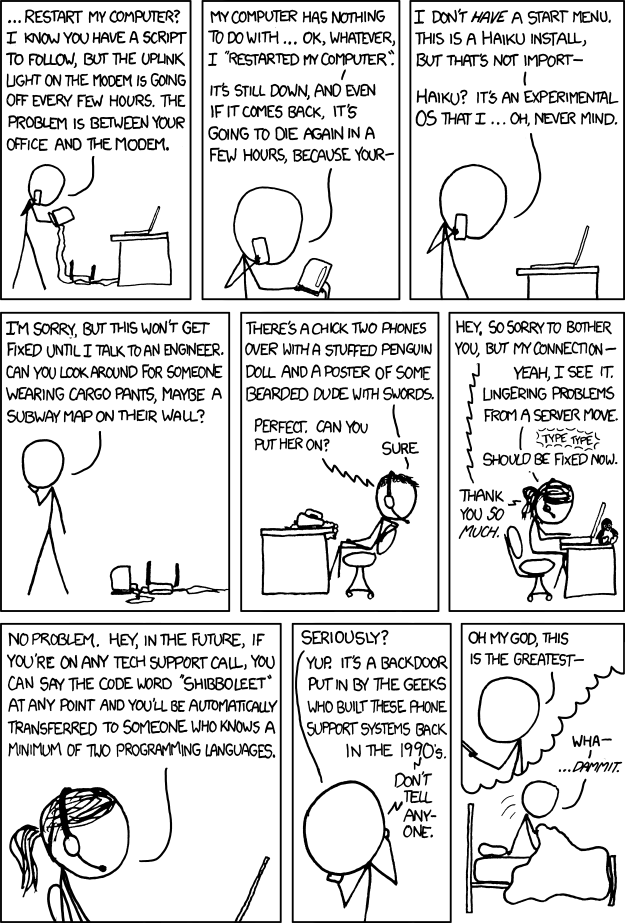
xkcd has a comic strip about an electronic services librarian's dream. How true!

Hat tip (and thanx for the laugh): Meg Kribble

New law school breaks ground in Nashville

Belmont University in Nashville, TN, broke ground yesterday on the $32 million, 71,000-square-foot Randall and Sadie Baskin Center, home for a brand  new College of Law (with eventual enrollment of 360 students) and "state-of-the-art" law library,slated to open in fall 2012 The building is being designed with the needs of law students in mind and will feature numerous amenities including a student commons, wireless Internet access, offices for student organizations, a locker room and food service, according to the university's press release.

Federated search engine for US government documents

Speaking of the Government Printing Office, it has recently introduced Metalib, a library portal that provides an easy interface to search simultaneously through a variety of electronic resources, such as catalogs, reference databases, digital repositories or subject-based Web gateways. This federated search engine ("federated" means it searches multiple databases) searches across U.S. Federal government databases, retrieving reports, articles, and citations while providing direct links to selected resources available online. When you find the information you need, MetaLib provides tools to save it for future reference in your E-shelf, save it to disk or send it by email. You can search multiple databases in parallel using the Basic, Advanced or Expert interface. You can also search individual databases using theA-Z Resource List , which enables you to locate specific databases from the wide range of databases available. The A-Z Resource List also lets you create your own sets of databases for searching at your convenience. In addition you can link to the native interface of a database and use that for searching.

hat tip: Joe Hodnicki

U. Va. celebrates 100 years as depository library

The University of Virginia library is celebrating 100 years as a federal depository library. To mark the occasion, he library is mounting an exhibit called "An Army of 100,000,000": Celebrating 100 Years of Government Information at U.Va." The exhibit focuses on WWI and how the Government Printing Office, along with the Committee on Public Information, urged Americans to support our soldiers as well as our allies and the war effort. WWI posters, pamphlets and other materials from the depository collection are in the exhibit. There is more information and a few posters available for viewing at the U. Va. library website.

Tuesday, 12 October 2010

Religious vanity plates OK

The WSJ Law Blog reports that the 2nd Circuit Court of Appeals in New York has reversed a lower court ruling in favor of the state of Vermont in a case where the state had rejected a Vermonter's request for a vanity license plate containing a Biblical reference. The appeals court ruled Friday that the First Amendment leaves room for religion on vanity plates. Shawn Byrne, the Vermonter who brought the case, had applied to the state for a vanity plate reading "JN36TN", which he says is a reference to the Bible verse John 3:16 ("For God so loved the world..."). The AP said of the ruling ""THE REV" and "PSALM48" can now join "ARMYMOM" and "DARE2BU" on the license plates of cars in Vermont."
In its opinion the court writes, ""The state rejected Byrne's message only because it addressed ... areas of otherwise permissible expression from a religious perspective.  This the state cannot do." The court also emphasized that its ruling was limited to the state's ban on religious messages;  the state can keep its ban on vanity plates that refer to scatological subjects, genitalia, illicit drugs, racial epithets and other objectionable material.

More on social networks and politics

Just after Malcolm Gladwell's article was published in The New Yorker, Frank Rich had an op-ed in the Sunday New York Times called "Facebook Politicians ARe Not Your Friends". The op-ed brings together Gladwell's article and the new movie about the Facebook founder called The Social Network and takes  a generally cynical view of social networking and its effect on democracy. Mr. Rich writes "the democratic utopia breathlessly promised by Facebook and its Web brethren is already gone with the wind.  Nowhere, perhaps, is the gap between the romance and the reality of the Internet more evident than in our politics. In the idealized narrative of digital democracy, greater connectivity has bequeathed more governmental transparency, more grass-roots participation and even a more efficient rendering of political justice... But you can also construct a less salutary counternarrative....The more recent miracle of Twitter theoretically encourages real-time interconnection between elected officials and the citizenry. But it too has been easily corrupted by politicians whose 140-character effusions are often ghost-written by hired 20-somethings...When South Carolina governor Mark Sanford was pretending to hike on the Appalachian Trail during his hook-up with his mistress in Argentina last June, his staff gave him cover by feeding his Twitter account with musings about such uncarnal passions as 'Washington D.C. financial recklessness.'"

Friday, 8 October 2010

Malcolm Gladwell : Why the revolution will not be tweeted

Malcolm Gladwell had a thought-provoking article in the New Yorker last week, titled "Small Change
Why the revolution will not be tweeted", in which he looks at social media like Facebook and Twitter.  He compares social activism in the 1960's and social (media) activism today: the civil rights protests that engulfed the South in the '60's, he points out, happened without e-mail, texting, Facebook or Twitter. He goes on to discuss how low-risk online social activism is.  He says " Social networks are effective at increasing participation—by lessening the level of motivation that participation requires. The Facebook page of the Save Darfur Coalition has 1,282,339 members, who have donated an average of nine cents apiece. The next biggest Darfur charity on Facebook has 22,073 members, who have donated an average of thirty-five cents. In other words, Facebook activism succeeds not by motivating people to make a real sacrifice but by motivating them to do the things that people do when they are not motivated enough to make a real sacrifice. We are a long way from the lunch counters of Greensboro."